
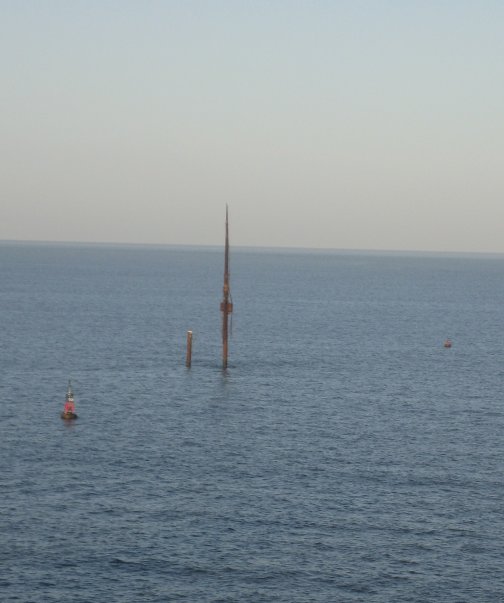
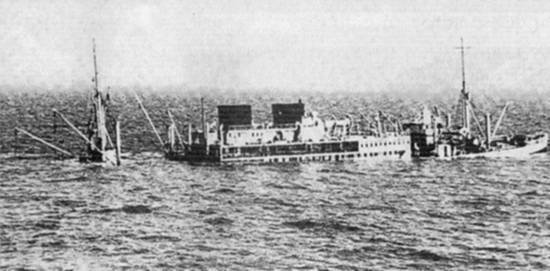
As you come up the River Plate to Montevideo you can see the mast of the Highland Chieftain sticking out of the water from miles away. The un-initiated on the ship thought that this was the remains of the Graff Spee. No such luck as she lies broken up underwater some 3 miles away.
The Highland Chieftain was built in 1929 by Harland and Wolf of Belfast, and made her maiden voyage on the London toRiver Plate service, on the 21st of February and later transferred to Royal Mail in 1932. She commenced wartime trooping duties in 1939, but was damaged on the 11th of October, 1940, during a bombing raid on Liverpool.
After the war she did not resume her commercial operations until 1948 on the River Plate service, and was sold out of the fleet in January of 1959 to the Calpe Shipping Company of Gibraltar and converted for use in the whaling industry,and renamed Calpean Star.
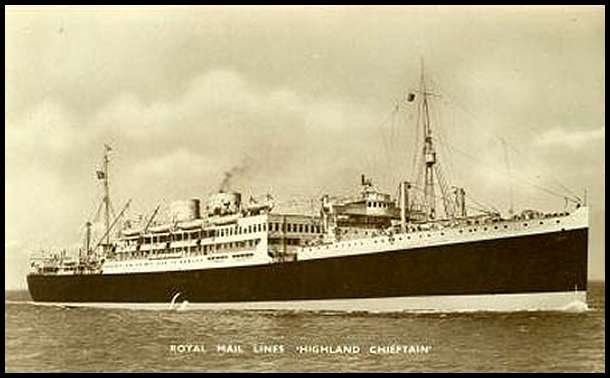
In March of 1960 she suffered rudder damage when off Montevideo, and after leaving under tow she suffered a boiler room explosion which resulted in her being abandoned.The wreck wasn’t cut up for scrap until 1965.
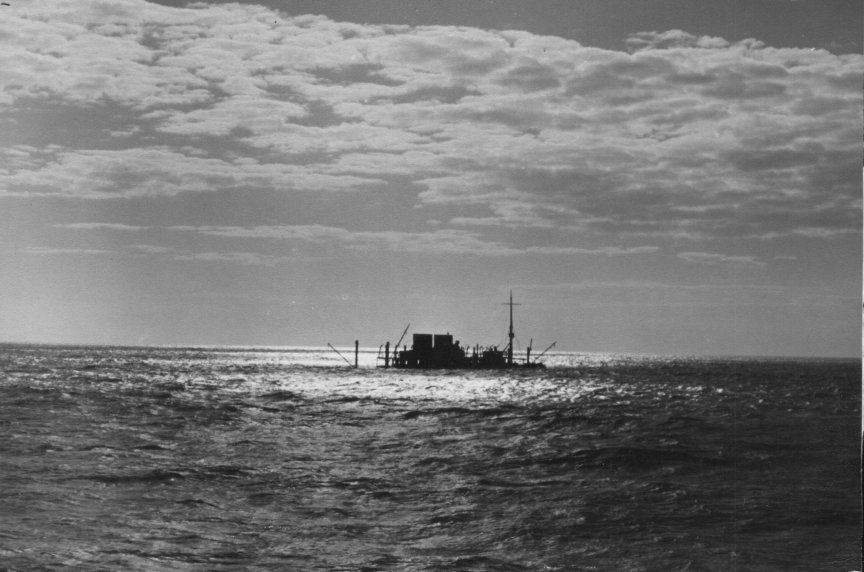
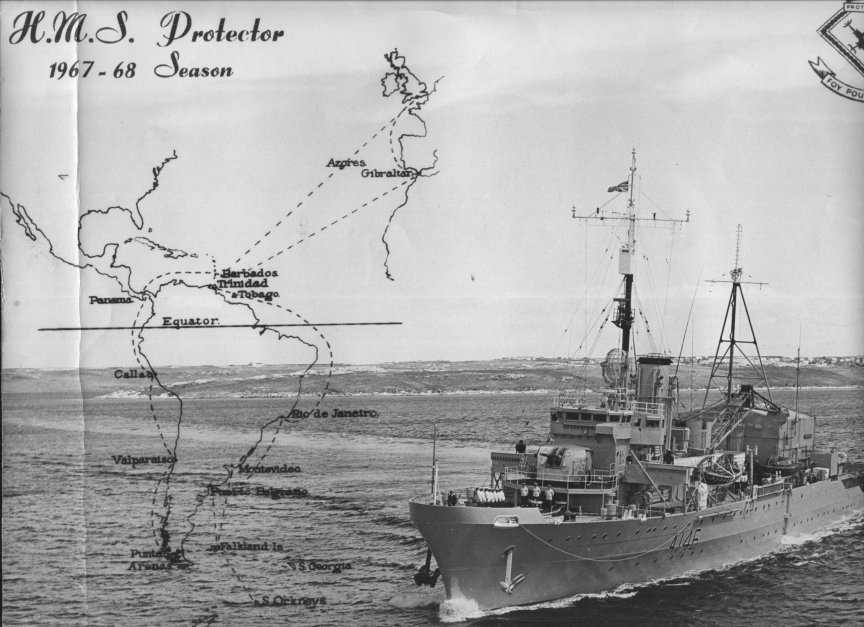
I am very grateful To Andy Jones for the following information and photos. He took the silhouette photo whilst serving on H.M.S.Protector in December 1967
Andy Jones: I believe I photographed the Highland Chieftain (Calpean Star) in 1967. At the time I was serving in the Royal Navy on board HMS Protector the navy’s antarctic patrol ship. We were entering Montevideo for the Christmas period. I was on the upper deck with my camera and took a sunlight silhouette photograph which later won a photographic competition. Oddly you say the ship was cut up for scrap in 1965, if the ship I photographed is the same ship then it was far from being cut up by late 1967. The photograph I have shows the two funnels, bridge and one deck below the funnels. Apart from the foremast, two derricks on the foredeck and two on the afterdeck the rest is sunken. I have viewed the photograph you have and cross matched it with my photograph and I am about 90% sure it is the same ship. Other photographs I have seen only show the foremast and the top of the front derricks. I may have the only photograph of the Highland Chieftain as it was in the 1960’s.
Article translated from Spanish. This vessel has known better times, of course. Was launched in 1928, Known as “Highland Chieftain” Part of a fleet of several cruise ships (passenger ships and cargo) identical. After passing the usual tests, entered service in 1929, A maiden voyage between London and Buenos Aires. It continued for years doing transatlantic voyages carrying cargo and passengers between Europe and South America. Displacing 14,000 tons and measured 163 meters long. Accommodate 150 passengers in the luxurious first class, 70 passengers in second class and to 500 in third class (something tells me that the latter were crowded, no?)
At the outbreak of World War II, the British seized it for use as troop transports. In that role the ship suffered bombing that severely damage it and put it out of service until 1948. In 1959 was acquired by the company “Calpe Shipping Co., and entirely refurbished and renamed Calpan Star. In early summer of 1959The ship carrying a cargo of birds and other animals to a zoo in Germany. Among them was an albatross, Large-sized seabird. Prior to arriving in port, one of the sailors gave the albatross improper food and he died. This situation is unfortunate, in the beliefs of the seamen, who identified the bird as a “symbol of friendship” and avoid disturbing them or hurting them. So it was no surprise that on reaching the next port, Liverpool, several of the crew demanded their pay and chose to stay there, knowing that the vessel had been “cursed.”
With some replacement crew, Calpean Star completed its journey, being allocated to the Norwegian fleet after the Antarctic. And there the trouble began. The ship suffered first several faults in the generators. Repaired them, then detected a leak of oil into the water supply. Then a break in the main engine compressor would leave it adrift for several days. When the repairs were completed, the rudder of the ship suffered a fracture, such that it had to be towed to Montevideo to solve the problem.
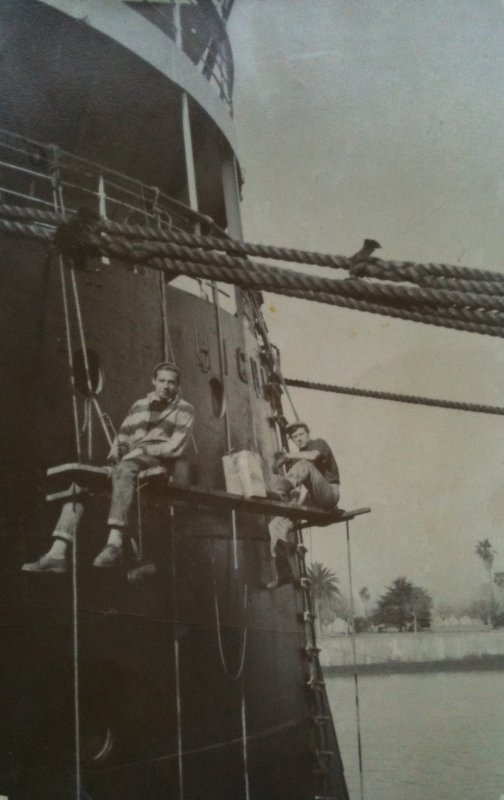
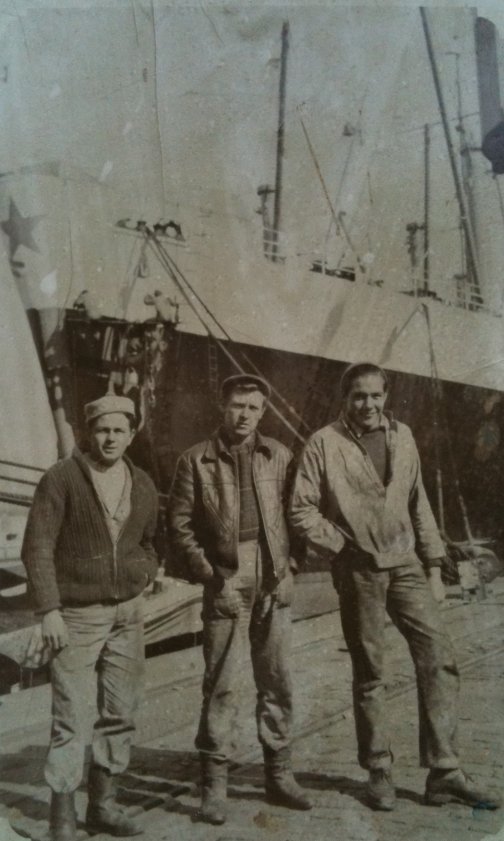
I am grateful to Craig Pearson for sending the photos below of his Uncle and two friends around 1950. If anyone knows who the crew are, please get in touch.
This was done and the necessary repairs were completed. But just as “Calpean Star”Left Montevideo, a huge explosion destroyed the engine room and started a fire. Crew members drowned during abandoning ship, which many identify with the sailor who killed the albatross. And the ship would founder hopelessly damned.
The curious fact: the ship’s remaining crew were repatriated by air. And in the first leg of the trip had a problem: the landing gear of the plane broke down when it landed in Rio de Janeiro. The seamen declared that only by coming back to their land felt that the curse was over. Believe it or not.
I am grateful to Ian Fordham for this photo of his Great Uncle, Alfred Roy Murley, and the information below
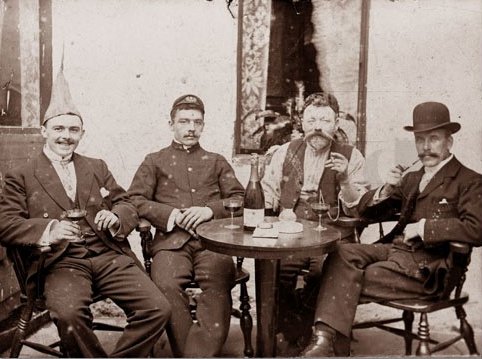
I attach a family photo taken in Swansea where the family lived about 1910 at some celebration, maybe Xmas? Alfred Roy Murley is on the left and his stepfather John Rowlands second right. Alfred was born Swansea in 1881, gained his masters certificate in 1902 and won the DSC at Gallipoli in May 1915 whilst Chief Officer on the Cardiganshire.He acted as a ship’s master with Royal Mail lines for many years both pre and between the wars. He served mostly on the S America run or to the west coast of the USA and Canada. At the start of WW2, I gather that the RM packets continued in service for a while before being assigned as troopships and operating with the convoys.His stepfather, John Rowlands was originally from Anglesey and also a master mariner. His boat was torpedoed by a U-boat in April 1915 off the Falklands and he went down with it. I was in a contingent of RAF trainee aircrew posted to South Africa for flying training and I boarded the Highland Chieftain in the centre of Glasgow on Sunday morning 18th July 1943. In the afternoon we sailed slowly down the Clyde and anchored in the vicinity of Gourock where a number of other ships were already assembling.The next morning we set off as part of convoy WS32 joining with convoy KMF20 the next day. We were escorted by three frigates and two sloops and joined by the cruiser Charybdis from the 22nd to 25th when we were joined by another four frigate and two destroyers until we reached Freetown on 28th.
I am grateful to Ted Gunn for the following information and photo.
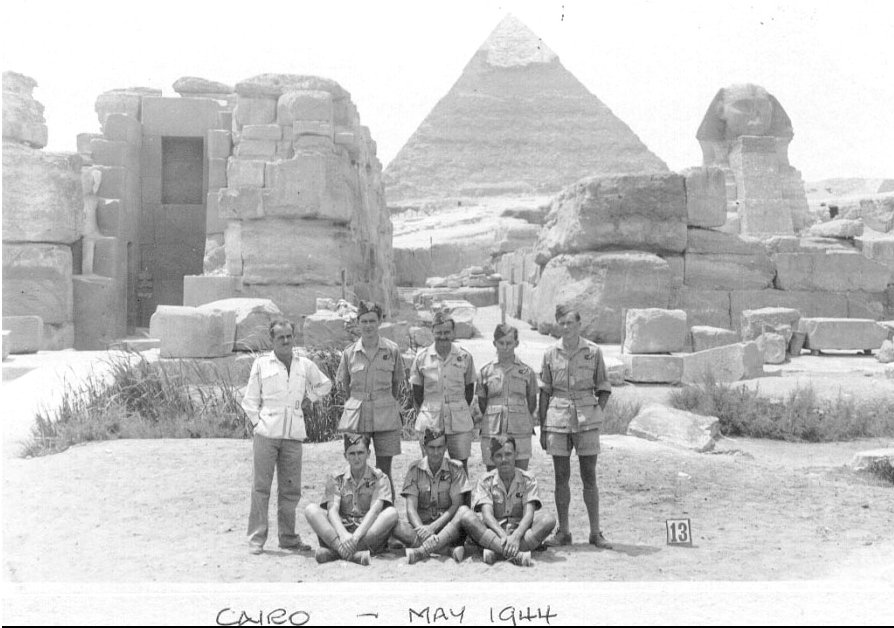
We sailed from Freetown on 5th August and before arriving at Capetown on 18th and we were escorted in all by eight destroyers and two frigates. We sailed from Capetown on 19th arriving at Durban on 22nd. Living conditions throughout were atrocious, fresh water was available for two half hour periods a day which, from my point of view as non tea drinker, gave rise to some dehydration especially through the tropics. In spite of poor quality food, the galley staff managed on a number of afternoons to produce some excellent corned beef bread rolls which they sold to those lucky enough to get to them before they sold out.
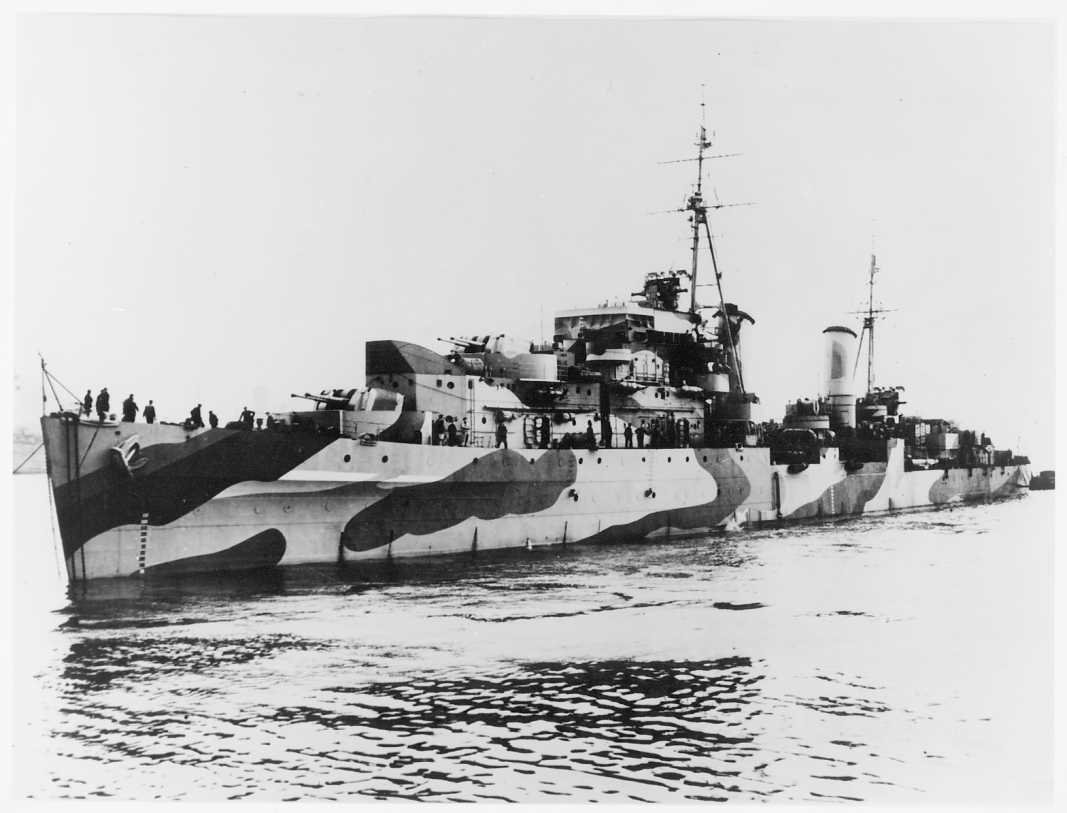
We were accommodated in the holds of this cargo ship which had been fitted out for the refrigerated transportation of meat and those who could not find a space to sling their hammocks from the cooling pipes near the ceiling slept on the floor. We were not allowed below between meals and with around 1300 service men on board finding a space to sit on deck was a problem (there were no seats) – sitting on our lifejackets provided a little comfort. This was not a cruise that would appeal to holidaymakers.
I am grateful, again, to Ian Fordham for this information about the part the Highland Chieftan in the sinking of the battleship Graff Spee.
On 8th December, 1939, the Highland Chieftan acted as ‘bait’ to draw the Graf Spee into an attack by making an announced departure from Rio de Janeiro bound for the River Plate – but secretly shadowed by a Royal Navy force commanded by Commodore Harwood and assembled to hunt for the Graf Spee. (In fact the Graf Spee was, unknown to the RN, already bound for the River Plate looking for the sister ship of the Highland Chieftan – the Highland Princess). After the Graf Spee was sighted and attacked and damaged by Harwood’s force, it took shelter in the neutral waters of the River Plate close by the anchorage of the Highland Chieftan which had by then made port. It was being held at anchor under RN orders as it was thought the Graf Spee might sail again but was not allowed, under international law, to leave port within 24 hours of a combatant merchant ship. So, the RN was allowing one British ship a day to leave and thus blocking any departure of the warship whilst it awaited reinforcements.
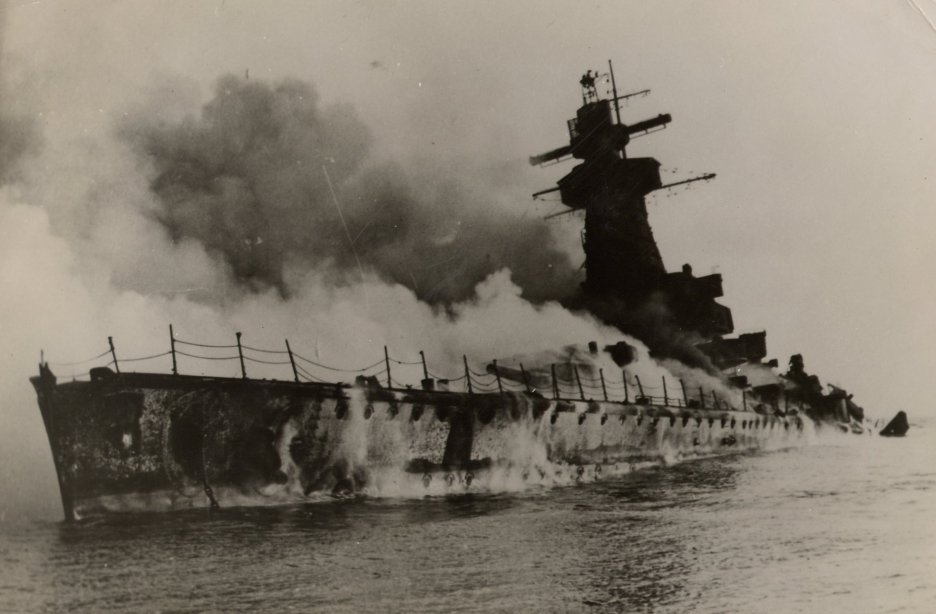
The Germans were under the impression that the RN force assembled to hunt it and standing offshore was much more powerful than it really was and sought approval from Berlin to inter the ship or to scuttle rather than to venture out to sea and engage. Berlin ordered the scuttling as it did not want to risk the boat falling under British control at some point. The Highland Chieftan took on board 60 merchant seamen prisoners released by the Graf Spee when at anchor and was still close by on the night of the 18th December when the Graf Spee was scuttled. These events are recorded in the diary of the Master, T Purcel-Buret, held at Greenwich. The British Naval Attache in Buenos Aires, Capt (later Admiral) Henry McCall sent a message to London on 21st December, that the Highland Chieftan was ready to sail to the UK with the released seamen.
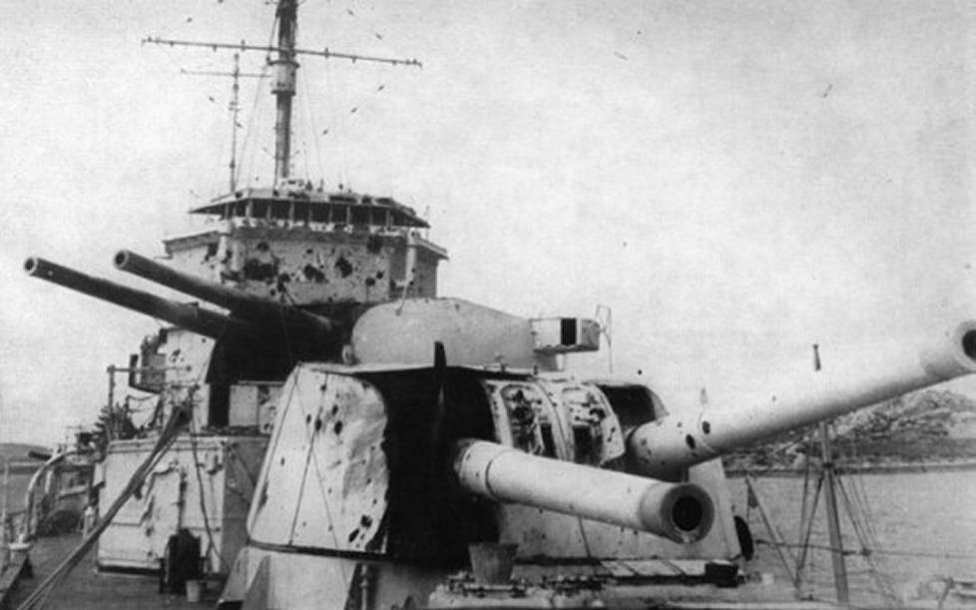
Highland Chieftan made at least 3 more voyages from the UK to the River Plate during 1940 and was damaged by German bombs when docked in Liverpool on 11th October, 1940. It then sailed twice to South Africa during 1941 following conversion as a troopship – as part of convoys WS5A and WS8B. It was thern involved in a heavy collision with the much larger troopship, Dominion Monarch during 1941 when part of convoy WS8A and, as a result, spent several months under repair in dry dock in Durban.
I am grateful to Michael Richardson for the photo of his Father, and an extract from his diary.
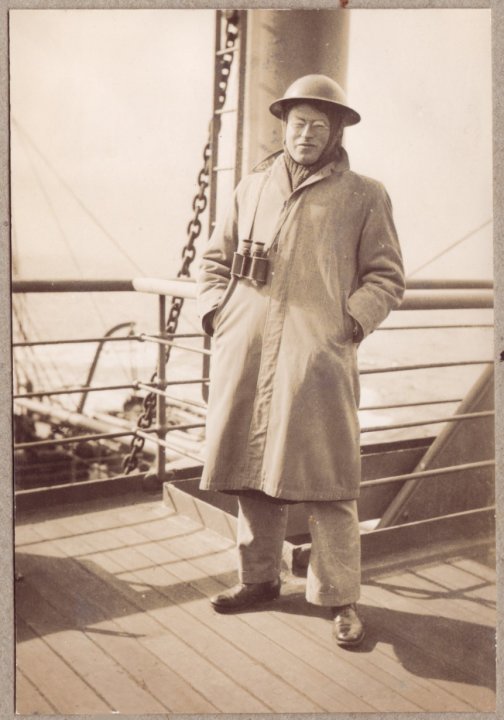
Diary extract: Diary of my father’s voyage from Buenos Aires to Liverpool on Highland Chieftain. Mar-Apl 1941
Sun Feb 23rd. H. Chieftain noted in Prensa. (Latin America News Agency) During the following week he was busy with a round of social engagements and completing his work in B.A. for the Gourock Ropeworks Company. Tues 4th Mar. A day on which I felt neither here not there. Furlongs came for my things about 9 o’c. …. Roberts drove me to the boat .. many on quayside seeing off volunteers (for the British forces ) .. mothers, fathers, sisters and sweethearts, I suppose. Layout of ship very familiar. Met several acquaintances in crew. At table with two ship-wrecked ships’ officers (Captain Caird and Chief Engineer from Eurylochus). Still at quayside at 10 p.m.
Wed 5th Mar. Woke up just in the same place & spent a nice sunny day by the dockside. Water too low to move. Av. Star just beside us with Mennonite settlers for Paraguay. Men with beards, women with head kerchiefs and long skirts and aprons & many children.
Th 6th Mar. We left about midnight and arrived Monte about noon. After lunch went ashore with Thomas .. back on board for dinner. Saloon practically empty. Talking to ship-wrecked Chief Engineer Creech afterwards.
Fri 7th Mar. At sea. Little to report, spent lazy day.
Sat 8th Mar. Pleasant day but not very sunny or warm. Up for P.T. with Volunteers at 7.30 and at ‘spotting’ class. Walked, talked and drank with the two ships officers etc.
Sun 9th Mar. P.T. at 7.30, quite strenuous. Service at 10.30 well attended and liked by all with the hymns all know. Played bridge after dinner with 3 Volunteers – Harding, Fitzpatrick and another.
Mon 10th Mar. Much warmer. P.T. in morning but couldn’t face second dose in evening. At classes on H.A. and Hotchkiss. Had a swim – pool filled for first time. After dinner liqueurs at Chief’s expense – he won the sweep !
Tue 11th Mar. Warm and gloriously sunny. Had a swim after morning P.T., another before lunch. H.A. and First Aid classes. Won 11/- in sweep – it all went on drinks. Dozed in deckchair till 1 a.m. Many sleeping on deck. Wed 12th Mar. Fine sunny day – got quite burned. At gun drill and Hotchkiss; 8 likely lads chosen. Up for P.T. at 7.30 & swim after it.
Th 13th Mar. Steward off sick – got no morning tea ! Swimming pool empty – to save water. P.T. at 7.30 also at H.A. gun drill and spotting talk. Sun almost overhead.
Fri 14th Mar. P.T. at 7.30 & swim in refilled pool. Military drill at 9.30. Got quite burned sunbathing & had another swim etc etc. Volunteer watches to start on Sunday.
Sat 15th Mar. Took things a bit easier. Very warm. P.T. & swim before breakfast. Boat drill in afternoon. Some excitement when we sighted another ship.
Sun 16th Mar. Cut P.T. and pool too empty for morning swim – had one before lunch. Divine Service at 10.30, siesta in afternoon. Watches begin today. I’m to start at 1 a.m.
Mon 17th Mar. St. Patrick. Did spells of duty at 1 a.m. and 3 a.m. and again in afternoon. ‘Irish’ cocktail party before dinner & I wined the table. More drinks after dinner but Caird, Creech and I quit when drunken Irish electrician arrived.
Tues 18th Mar. Up at 6.30 feeling quite fit. Had a swim, definitely cooler. On watch at 8 a.m. Sunbathed in afternoon. Had sleep after dinner and prepared for 12 o’c watch. Wed
19th Mar. Duly kept watches. Capt. C pretty bottled for his. Up 7 o’c; original cabin steward back. In sight of land (C Verde) from breakfast time and all forenoon. Siesta after lunch and slept on so kept watch 5 – 6 and 7 – 8. Dark and rather cloudy night.
Th 20th Mar. On watch 8 – 9 and 10 – 11. On first period reported ‘object’ which was shark’s dorsal fin cutting the water. We were issued with civilian respirators. After dinner we had boat drill in darkness.
Fri 21st Mar. On watch again at 1 a.m. Rising crescent of dying moon looked red and ugly. I hailed gun deck, after persuasion by partner. No 4 also reported it. Took afternoon watch. Scharnhorst and Gneisenau reported at large.
Sat 22nd Mar. Morning watch. Voyage drags. Captain Robinson hints another week.
Sun 23rd Mar. Rather cloudy. Church at 10.30. Mon 24th Mar. Wind, choppy sea and squalls of rain in forenoon. Issued with oilskins and sou’wester for morning watch. Night watch suspended.
Tue 25th Mar. Cold, windy and squally with the ship riding bravely through heavy seas. I kept morning watch. First Aid lecture by Dr Dean in afternoon.
Wed 26th Mar. Took watch from 5 a.m. Very cold and rough. Creech stayed in bed most of day. I spent afternoon in bed. Heavy seas striking the side came into cabin by the ventilator.
Th 27th Mar. Wind and sea moderated & a sunny day, though cold. On watch from 4 – 5 only.
Fri 28th Mar. Nice day, cold but sunny. Captain not having meals in saloon after today. Took watch in afternoon. On deck several times to see wonderful display of Northern Lights. North star very high – 60 ° ?
Sat 29th Mar. Nice sunny day. On watch 8 – 12 a.m. and 8 – 12 p.m. About 11.15 a short blast on the siren caused considerable excitement but it was an accident !
Sun 30th Mar. A crisp sunny day. No service as all too busy. Some light snow showers during the day. At 12.30 when I was on watch the alarm was sounded but thank God it was a Lockheed Hudson, which flew around us all afternoon. Saw some distant ships and at night lighthouses on shore. Northern Lights on view again. Mon 31st Mar. On watch from 5 a.m. to 8 a.m. The sun was red over the snow-covered hills. We came amongst the rocks and islands of the Hebrides. Saw destroyer flotilla, aircraft etc. Damn cold on watch, we had snow showers later. Siesta after lunch. Night watch postponed. Tue 1st Apl. In Irish Sea; packed in morning. Got into Mersey about 1 o’c. Played bridge till the tenders took us ashore about 5 o’c.
(He then travelled to Manchester to his in-laws house and met my mother again for the first time in eight months; they slept in the cellar that night).
Transcribed by Michael Richardson. February 2013.
Michael Richardson also sent in the drawing his dad made of his cabin with a neat description.
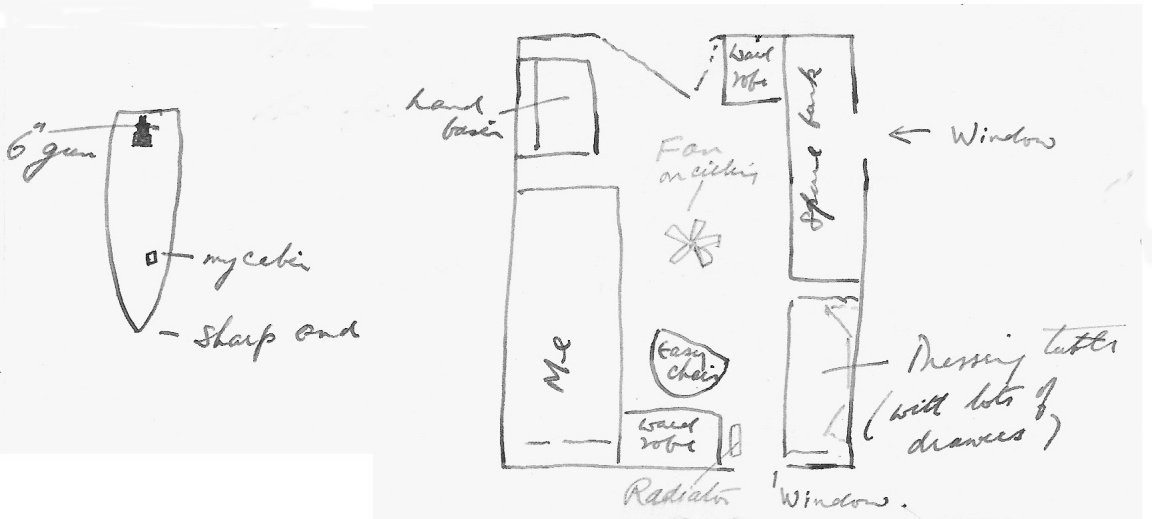
That is a very bad drawing, but actually it is a very nice cabin, and of course I have lots of room in it, as it is really meant for two persons. I’ve got clothes hangers galore, and hooks on the walls besides. We ‘black out’ at 6.30 (ships time), and the sun goes down very suddenly about 7o’c. There is little twilight. The officers are now dressed in whites. I’m running round in short (sic); the Daks are very neat, but I’m not keen on the blue. A khaki drill or linen pair would have been useful.
Michael comments: I see that there continue to be a few new comments on the website, but what would be really great would be to hear from any descendants of the two shipwrecked officers that my father mentioned.
I am grateful to William McKay for the photos and information below.


William has also provided this photo, which he is sure is the Captain of the Highland Chieftain with his family.
I am grateful to Brian Nash for providing the information and photo, below, of his Grandad, William (Bill) Rogan
Most people will be familiar with the poem of the Ancient Mariner, by Samuel Taylor Coleridge, in which disaster follows the death of an Albatross. This is the first time I have ever come across a modern counterpart. After a ten year absence, Bill Rogan, aged sixty one, went back to sea in 1959, in order to fulfil a promise to send money back each week, to his old shipmate ‘Spud’, who had lost a leg due to an illness. Unfortunately he chose a ship, the ‘Calpean Star’ that had a reputation as a ‘hoodoo’ ship.

The Calpean Star had arrived back in Liverpool from the Antartic with a baby albatross on board. Two days later it was dead. and that’s when the troubles started. First the ships generator broke down and had to be replaced, then there was a fight and some of the crew walked off the boat to be replaced with Norwegians. A bomb hoax and a fire alongside the ship swiftly followed, and nearly a year later, Lloyds of London reported an explosion aboard the ship, which flooded the engine room, drowning Bill Rogan. He left behind seven daughters and a son.

One of his daughters, Mrs. Eileen Sage, said that all his friends tried to stop Bill from joining the ship, but he yearned to go back to the sea.

r.g.church says
this is a bit confusing! as a raf serviceman, i embarked on the highland chieftain (as part of a convoy) in april 1941. we were in collision with another ship in the convooy, and had to limp alone to capetown. i still have fond memories of the highland chieftain, as with the other ships in the convoy, namely the dominion monarch, as well as other ships.
Andy Jones says
At the outbreak of World War II, the British seized it for use as troop transports.
Elizabeth Bailey says
We sailed to Santos on the Highland Chieftan, leaving from Tilbury on 10th December 1955. I was 7 years old and remember the voyage vividly. The Bay of Biscay was horrible but stopping at Vigo, Oporto, Lisbon, Las Palmas and Rio was very exciting for a small kid from post war Leeds. Our stay in Brazil didn’t work out and we returned to the UK, leaving from Santos in mid April 1956.
Crossing the line was great fun. A member of the crew dressed up as King Neptune and all the kids got a ducking in a make-shift pool.
Strangely enough my Dad also sailed on the HC when it was a troop ship during the war
Pete Kemp says
Hi there. My Gradndfather ? Cables was serving on the HC when he died, apparantly he fell into the Hold around 1939. I think it was in Las Palmas where he is buried. Would love any info. Thanks Pete
David Menzies says
I saw & filmed this vessel in Montivideo in April 1976 on the way back from Australia on the liner Shota Rustavelli.
I have a slide of her.
My late Father was on the Highland Princess at the out break of war.
D. Menzies Secretary Bedford Branch.
World ShipSociety.
paul johnston says
My father was chief engineer on this vessel at teh time of her last voyage. Having struck rocks entering Grytiviken harbour attempts were made to repair her by jury rigging a rudder, these were unsucessful and teh ship was towed to montevideo where repairs were successfully carried out. On leaving the shipyard, the boat ran aground and during attempts to get her off suffered an engine room explosion. The ship was subsequently sold to a uruguayan salvage company who cut holes in her side to allow water in with a view to balancing the ship to float her off . The boat settled in the mud and gradually sank into it leaving only the masts showing. I remember much of the antarctic phase of the trip since I was actually on board (at teh age of 5) unlikely as it sounds!!
Storm says
Tomorrow i will post links to two photos of my uncle and his two friends painting the Highland Chieftain. This must have been around the mid to early 50’s. But I’ll check that date.
Maria Palmira R Fernandez says
Sorry that I did not know how to write English correctly. I am Brazilian.
Gentlemen,
I would like to inform you that my mother Maria Ivonne R Fernandez left the port of Vigo in Spain on 18/11/1947 aboard the Highland Chieftains and arrived at Santos, Brazil on 5/12/1947, so
repairs after the attack suffered during World War II he returned to active in 1947 and not 1948.
If necessary I can send the scan of her passport for verification of data.
I think we all have to help make the most accurate possible data on the Web, even if they are small changes.
Grateful for the attention
Maria Palmira Rodriguez Fernandez
Ribeirao Pires, São Paulo, Brazil
mprfernandez@uol.com.br
P. Pescador-Smith says
My Great Uncle served in the RAF was on board the Dominion Monarch when it collided with the Highland Chieftain, his diary dates this as ‘Thursday 8th May 1941’ when they were woken by four crashing noises,and thought they had been torpedoed. After parading quickly to find they had collided they were back in bed for 5am.
Alex Domínguez says
Hi from Spain, I found this page looking for photos from the vessel “Highland Chieftain” my mother left the Vigo harbour in this ship in the year 1954 and her destiny was Montevideo.
N.C.MacGregor says
I spent eight years on Highland Monarch (one of Chieftains sister ships)and remember passing the wreck of Highland Chieftain soon after the event of her wrecking.What annoyed all aboard the Highland Monarch at the time of passing the wreck, was,that after many years of being manned by British crews,surviving the second world war and completing many more years in the ownership of Royal Mail Lines Limited, she was destroyed by (apparently), an incompetent crew.Due to her wrecking having just occured prior to us passing her outside of Montevideo harbour,she hadn’t had time to settle very much on the bottom and had the appearance of being very overloaded, with her main decks only just above the water line. She made a sorry sight as we passed her.
Brian Nash says
My grandfather was one of the replacement crew that boarded in Liverpool after the albatross. I have some cuttings from the Liverpool Echo telling of the ship being abandoned in Liverpool and their struggle to find replacement crew on the “jinx ship”. My grandfather died whilst the ship was being repaired in Montevideo. He tripped over a rope on his way home when he was a little worse for wear and fell into the dock and drowned after knocking himself out. He is buried in the british embassy in Montevideo. His name was William Rogan and he came out of retirement to join the ship. He was the oldest guy on board. I have seached before for stuff about the ship and there seems to be a lot more than there was a couple of years ago. Thank you for the information.
Elma McIndoe says
My father served on the Highland Chieftain during the war and he was discharged in 1944. Would like to know more about the ship’s years and voyages as troop carrier.
James Skinner says
Brings back memories. I travelled on her on return to Buenos Aires in 1950 as a 10 year old kid. Remember seeing her remains years later as I again returned to BA onboard the Argentine Dodero liner ‘Libertad’.
Greg Cook says
My Father sail on H C from 24.05.47 to 31.07.47
His name was Ernist Cook now known as Robert Ernist Cook if any one knows any more info I would apreicate it.
Regards Greg
Conn Crowley says
My father Patrick G (Ger) Crowley served on the Highland Chieftain in the 1930’s I have a Photo of him in Buenos Aires in May 1938.
How would I access crew manifests etc for that time
Ariel Martinez says
I would like to invite you to visit the facebook site where I’m gathering, testimonials, photos and documents about the history of Highland Chieftain.
http://www.facebook.com/group.php?gid=126987297322534&v=wall
Regards
Ariel Martinez says
My e-mail for contact or send photos and documents about Highland Chieftain.
arieleme@gmail.com
Andrew Clarke says
Highland Chieftain
For some time now I have been trying to piece together information about my step-brother Geoffrey Clarke, born in 1910, now deceased but who spent the war years in the British Embassy in Montevideo, Uruguay, on the staff of the Naval Attaché. He may even have been the Naval Attaché, as he was promoted to the rank of Lieutenant-Commander during his posting there, as is evidenced by a letter of congratulations in Spanish, of which I have a copy, that he received at the time from the Uruguayan authorities.
Either because of his natural reticence or possibly for reasons of security, he never spoke much about his time in South America, limiting himself mainly to the story of the scuttling of the Graf Spee, which occurred while he was there and of which he had several black-and-white photographs, now unfortunately lost, taken from the shore.
I knew that he had travelled to Montevideo in a ship called the Highland Chieftain, which I now find is the subject of a number of recollections on websites. The account that circulated in the family was that as a young RNVR officer he was at the outbreak of war told to report to the Highland Chieftain, presumably at dock in some port such as Liverpool. On board he found himself in the company of several young men in plain clothes who all turned out to be British Naval officers. One was dropped off at each of various ports as the Chieftain made its way to South America, my step-brother being the last but one to disembark, at Montevideo, the last passenger presumably leaving the ship at Buenos Aires.
Though these events date back some seventy years, I would be interested in obtaining: (a) any details or memories anyone may have of this particular voyage, passenger manifest, route, dates, etc., and (b) information concerning the activities and staff of the Naval Attaché in Montevideo at the time. In particular, I have always been intrigued why my step-brother, whose many qualities did not to my knowledge include any acquaintance with or interest in Latin America and who did not speak Spanish or any other foreign language, should have been chosen for this posting. This latter part of my search would probably best be conducted via the War Museum, but not being very computer-literate, I wouldn’t know how to go about it and, of course, there may well be, even now, security-related objections to releasing such information.
My heartfelt thanks in advance to anyone who can help.
Andrew Clarke, Brussels, Belgium, February 2012
Lesley Russell says
Hi I have just found what looks like an immagration document dated 1937. It is from a crew member of the M.V. Highland Chieftain.
The name in the document is Johm Ivan Blair. I found this document in my Dads files. He was a customs officer , so he must have found it while on duty. I am looking forward to hearing from you
Lesley Russell.
Milo O'Shea says
I am the nephew of Geoffrey Clarke (mentioned in the comment by Andrew Clarke) and have in my possession his wartime letters to his sister, my mother.
Geoff writes on 25 August 1939:
”Well, old dear, I sail for Buenos Aires, Argentina in the morning (Sat.) at 12 o’clock and am going out there as the Consular Shipping Adviser (whatever that may mean!). Attached to the British Consul or that’s the bloke I have to report to. I’m the only one appointed to that city but there are a number of us appointed to travel in the same
ship which is the “Highland Chieftain”, Royal Mail Line, sailing from Tilbury. I have very few other instructions except that I’m travelling as a private individual – no uniform required at all, so I’ve shipped them home.” He then recounts rushing back to Wolverhampton & then back
to the Admiralty …”there is no easing up at H.Q. More activity if anything.”
In the bundle there are numerous letters on HChieftain stationery (as yet unread by me) and also postcards of both The HC & HMS Newcastle.
Milo
Nick Musgrove says
My grandfather, Charles Musgrove, 1875 – 1942 was a “First Baker” on Highland Chieftain. His log books show he did 20 voyages from Victoria Docks to the River Plate between Feb 1929 and Nov 1932. He then moved on to Highland Princess. Fascinating to learn of his old ship’s ultimate fate.
John Nicholson says
I hsve just recieved my grand fathers service book from the National Archives and it indicates that he was 2nd Cook on this vessel in 1940. His name was William Joseph Hitchcock. If anyone has any more information on this ship, viseos, photos etc please contact me – nicholsonjw@hotmail.com.
Kindest Regards,
John
E McIndoe nee Sloan says
Like J Nicholson my father William “Bill” Sloan served as 2nd butcher on the Highland Chieftain during the 2nd world war, any photos etc Would be of interest.
Joseph Duffy says
Whilst “Googling” one of my previous ships the
“Highland Princess” I came across the “Submerged” website and may offer some assistance. I would suggest trying another website called http://www.miramarshipindex.org.nz for detailed info on the Highland Chieftain. This website will give ships history from launch to end of service.
As a 17 year old 1st tripper I sailed as 3rd Radio Officer on the Highland Princess in 1958. Both my senior R/O’s sailed on her before,during and after WW11. As all 4 Highland Ships were identical in design, I do have photographs of the Highland ships and their luxurious 1st class passenger accommodation if anyone is interested.
Other maritime sites worth visiting are Ships Nostalgia and Merchant Navy websites (via google). Hope this helps.
Regards, joeduffy65@hotmail.co.uk
Rene Moortgat says
Hey Joseph,
Thanks for the information! My grandmother sailed with my infant father and aunt on the last voyage of the Highland Princess before she was retired in 1959. She was in second class but would regularly be invited to play the piano in one of the 1st class lounges for passengers (she was a piano teacher). Off the coast of Portugal, the Highland Princess was caught in a fierce storm, and was unable to dock for several days, being at the mercy of the sea. My grandmother describes the ship rolling, and how most on board thought she would be sunk by the great waves. A rope was installed on her stern deck between deck houses so passengers could hold on and not be swept to sea when crossing the deck. After days, the ship did weather the storm and sailed safely to London.
I would love to see your pictures of the Highland class ships Joseph. I have been researching the Highland Princess for quite some time, and coming across pictures is often very difficult. I would really appreciate the chance to see your photographs!
Cheers,
Rene – rene.moortgat@gmail.com
Allan Essex says
I Joined the Highland Chiefton as a cabin boy at the age of 17 in the mid 1950 And it was my first trip to sea after sea training school. She left King george the fifth dock in london in the early hours and picked up passengers from Tilbury.we Arrive at Vigo very seasick after a very bumpy crossing, then on to apporto,Lisbon Canaries and over to Rio deJanero. then to Santos and Montivideo.and Buanus aires.What a dreadfull experience. couldent wait to sighn off that old crate. She sailed like a pregnant whale. the crew cabins were like prison cells with steel bunks, and the food left a lot to be desired.
Michael Richardson says
I find some of the comments about the Highland Chieftain’s wartime service a little puzzling, as my father returned on her from Buenos Aires in Mar/Apl 1941, so she was definitely not engaged in trooping duties at that time. He had sailed out on the Highland Patriot in the previous August and of course she was sunk on her return voyage. In one of my father’s albums there are photographs, certainly quite a few taken on the HP and possible others from the HC. Would these be of interest ? I also have my father’s diaries recording his experiences on both voyages.
Michael
Ian says
Re the comments concerning Geoffrey Clarke. He was on the passenger manifest for the sailing of 26th August, 1939, with a destination of Buenos Aires and described as ‘naval officer’ and with a home address of Compton Rd, Wolverhampton. Strangely, his name is crossed through in pencil for some reason.
This was the last sailing pre-war and when the ship was requisitioned it was first used on the South American routes repatriating S Americans from Europe delivering German and other European nationals of jewish faith to safety in S America.
My great uncle was Master on that voyage though he normally sailed the sister ship, Highland Princess.
Ian says
Re Geoffrey Clarke:
HC left London 26th August 1939 and called at Boulogne, Lisbon, Las Palmas, Pernambuco, Santos, Rio, Montevideo and Buenos Aires.
There were more than 200 passengers including 14 naval officers and 1 Royal marine dropped off en route at each port except Boulogne. 5 left the boat at BA. (Navy travelled first class in those days!).
Edward Gunn says
I was in a contingent of RAF trainee aircrew posted to South Africa for flying training and I boarded the Highland Chieftain in the centre of Glasgow on Sunday morning 18th July 1943. In the afternoon we sailed slowly down the Clyde and anchored in the vicinity of Gourock where a number of other ships were already assembling.
The next morning we set off as part of convoy WS32 joining with convoy KMF20 the next day. We were escorted by three frigates and two sloops and joined by the cruiser Charybdis from the 22nd to 25th when we were joined by another four frigate and two destroyers until we reached Freetown on 28th.
We sailed from Freetown on 5th August and before arriving at Capetown on 18th and we were escorted in all by eight destroyers and two frigates.
We sailed from Capetown on 19th arriving at Durban on 22nd.
Living conditions throughout were atrocious, fresh water was available for two half hour periods a day which, from my point of view as non tea drinker, gave rise to some dehydration especially through the tropics. In spite of poor quality food, the galley staff managed on a number of afternoons to produce some excellent corned beef bread rolls which they sold to those lucky enough to get to them before they sold out.
We were accommodated in the holds of this cargo ship which had been fitted out for the refrigerated transportation of meat and those who could not find a space to sling their hammocks from the cooling pipes near the ceiling slept on the floor. We were not allowed below between meals and with around 1300 service men on board finding a space to sit on deck was a problem (there were no seats) – sitting on our lifejackets provided a little comfort.
This was not a cruise that would appeal to holidaymakers.
Andrew Clarke says
Thank you “Ian” for the details of the departure, destination, etc., of the HC with my step-brother on board. It’s possible he was dropped off at BA first, but he subsequently spent most of the war years in Montevideo, where he was stationed at the time of the Graf Spee scuttling in December 1939.
Submerged Comment says
Linda Fuller (lindafuller47@hotmail.co.uk) wrote:
My late brother-in-law, Robert William Fuller, sailed on the Highland Chieftain possibly late 1940?s early 1950?s. At this moment i am looking at a picture postcard of the HC and on the reverse side my brother-in-law has written “London, Vigo, Lisbon,Las Palmas, Rio, Santos, Montyvideo, La Plata and cook (La Boca.” and also 1. Pantry Boy – 1. Sculleryman – 1. Assistant Cook (Tourist) and 2. Assistant Cook (let Class)
He was learning to be a cook at the time and probably only about 16 yrs old or so.
Submerged Comment says
William McKay (William.mckay8@btinternet.com) wrote:
My father William McKay served on the Highland Chieftan during the war,as a steward.
He was around at the time the Graf Spee was scuttled.
I have a picture of the Highland Chieftan hanging on my living room wall.
Linda Henk says
I have a scrapbook from WWII, which was compiled by my parents, 1st. Lt. W.J. Gregory and his wife, Emma from 1943-1945. My father served in North Africa from Oct, 1943 through February, 1944. He sent a menu home to Emma, which was from the troopship that he sailed from North Africa to Anzio, Italy at the end of February, 1944. He wrote that the name of the ship was “The Highland Chieftain.” I’d like to confirm his entry; however, what I read on your site seems to conflict with his information. Can you help, please? Did the Highland Chieftain serve as a troopship to move troops from North Africa to Italy early in 1944?
Ian says
For Linda Henk
HC sailed from Liverpool mid January for Naples and spent the next 2 moths transporting troops between North Africa, (Oran) and Naples – which was the main landing point and South of Anzio itself.
There were 2 sailings that fit your story: 17th February arriving 20th and 29th February, arriving 3rd March.
Hope that helps.
Linda Henk says
It does. The February 29th sailing matches with my father’s arrival in Italy on March 3. I have a berth ticket and a menu for the voyage if you would be interested.
Thank you very much for your help. If you don’t mind, I’ll provide a link to this website in my blog, which features letters, photos, military orders, etc.
Ian says
Hi Linda.
Why not post the ticket and menu on this site? They would certainly add some interesting detail.
Can you provide a link to your blog?
James G. Skinner says
I travelled on the Highland Chieftain in 1950 as a kid.
Richard Davey says
Hi
Still finding my way around my late Dad-Len Davey’s career. Have been told by elder siblings that he was in Montevideo at the time of the Graf Spey in 1939, so that means he was on the H.C. the only two records I have so far, is that he signed on for the Highland Brigade from the 25 February 1938, obviously changed ships somewhere along the line. I do know he had worked on both ships, and was a Chef.
He was definitely on the H.C when the ship was bombed in 11th October 1940 at Liverpool. Hence he promptly left the Merchant Navy. A spell ashore then joined the RAF in Bomber Command. He rejoined the Merchant Navy 10th August 1948 on the RMS Andes.
If any one has any information, would be great to hear from you
Regards
Richard
Tony Parrish says
I found this site to be very interesting.
My late grandfather, William Norman, was on the HC from 1931-1933, then moved onto the Highland Princess, then onto the Rangi boats. In his effects, I found a silver football medal. On the reverse, it says ‘the mission to seamen, Buenos Aires, football league, 1933 winners, Highland Chieftain’.
In the same batch of papers, I found a picture of a football team, which features my grandfather, and on the reverse there is a faded stamp, in which we can just make out the words ‘Buenos Aires’. However, I am unsure whether this is the actual HC football team.
Any information would be very interesting and appreciated.
Kind regards,
Tony Parrish.
Brian Nash says
Can you tell me where I can send some newspaper clipping about the Calpean Star? I have three from the local paper telling the story of my Grandad’s death.
Michelle Johnston says
I was on board the Calpean Star in 1959 (as it was then named) with my Father (Maurice Johnston, Chief Engineer), Mother and older brother. It was sailing to South Georgia on a whaling expedition. We spent just under a year on board but as I was just 3 months old, I have no memories, just wonderful photographs and several whales tooth sculptures. My first words were Norwegian, courtesy of the Norwegian crew who often cradled me in their arms and cooed to me in their native tongue.
Vanessa Lee says
I’ve enjoyed reading this article and all the following comments about the Highland Chieftan. My father served on board the HC in 1942, he was a gunner and he spoke fondly of those days. I still have his immigration card amongst other things bearing the HC name.
R.M .Williams says
My father E.M.Williams was on this ship in 1928 as a Deck Officer. I have a few old pics .
EDWARD STEPHENSON says
Ijoined the Highland Chieftain april 1941 and was on board during the Dominion Monarch collision in convoy.
voyage ended march1942
still searching for my pal from the Vindicatrix who joined H C with me & came fron Doncaster
B Burgess says
Rather late to post this but I was just researching information on “residents” at the British Cemetery here in Las Palmas and can tell Pete Kemp (post in 2011) that his grandfather’s grave is here: full name was James Holden Cables and he was first officer on the H.C.who died 5.12.1931 aged 48.
About 30% of those buried here are mariners or sea passengers.
Contact via Holy Trinity Church website/facebook welcome
R Adams says
My dad was an officer on Royal Mail and served on several of the Highland ships including the Highland Chieftain.He took quite a few pictures of the Highland ships.He spent quite a few a few years chugging up and down to Rio with Royal Mail.
Del Brennan says
To Michelle Johnston
Hello Michelle I just read your post, I work with a man (75 years of age) who was a galley boy on the Calpean Star on her voyage to South Georgia. I read that you “have no memories, just wonderful photographs”. I was hoping it would be possible for you to share a copy of those photos with me so I can give to Micheal Gray (my workmate) as we are doing some research on this voyage. My email is sportslinkgroundstaff@gmail.com. I hope to hear back from you. Many thanks in advance
regards
Del
gail says
Ernest Cromack occ ships pilot, departed 15 Nov 1947 Tilbury London to Rio aged 74
This info is from the ships manifiest, an is a great uncle on my dads side of the family.
Marjorie Bennett says
My mother and I travelled out to Brazil (Santos) on the Highland Chieftain in 1953 and I subsequently travelled back to London (Tilbury) on the Highland Princess in 1957 at the age of 4 after her death at the end of 1956. I can just about remember the second voyage but needless to say have no memory at all of the first one. I had already been baptised by King Neptune when “crossing the line” returning to England from Melbourne in 1952 and have the certificate to prove it.
Gladys Utrera says
Hi,
My mother (11 years old), grandmother (34 years old) and uncle (9 years old) emigrated on that ship from Vigo to Montevideo in december 1955. I am very touched to see that there is another person (Elizabeth Bailey from Leeds) that went on the same trip! She might have seen my family there, maybe she has some photos of that trip? My email: gutrerai@gmail.com
As a consequence I was born in Montevideo (1969) and from several years, I grew up seeing in the Montevideo coast that ship drowning on the horizon. I don’t remember the age, maybe 15? I stopped seeing the ship as it finally drowned.
Cilla King says
I am researching this ship, which my father-in-law was on when he was in the RAF. he describes the collision with the ‘Dominion Monarch”. When I have finished typing his notes I could send them to you to add to this page, if you think it might be of interest. I also wanted a photograph of the ship which I could use; is that possible please?
Andrew Dingwall says
My father James Dingwall was 3rd engineer on Highland Chieftain from July to November 1937. I recall going on board while she was in dock – Liverpool I think although it may have been during my first visit to London – I have a photo of myself as a 5 year old holding on to the wheel whilst visiting the bridge. He had also served as 5th engineer on Highland Monarch in 1933.
My father retired in 1958 as chief engineer of Loch Gowan, which he found to be a “difficult” ship mechanically – I think she was broken up fairly early.
Johannes Bjorner says
The Highland Chieftain resumed comercial travel already in 1947.
My family traveled from South Hampton to Buenos Aires in February of 1947.
John Lamb says
John Lamb – DOB 15/01/1936 – I sailed as 3rd engineer on the Calpean Star during the voyage when she unfortunately sank. I remember fondly Billy Rogan who unfortunately died and is mentioned in this article, he was my donkey man. Reading this article has brought back many happy and sad memories, I remember this voyage like it was yesterday. Unfortunately I myself am not in great health and do not get to leave my house very often so these articles are wonderful to read and bring back memories of the good old days. With kind Regards John Lamb of Southport, Merseyside
Mrs. D. Bailey says
My father was a Japanese POW [Burma Railway] who travelled home on the Highland Chieftain in Sept/Oct 1945 . The ship was boarded by some 600 men leaving Singapore on the 24th September and called into Darwin on the 2nd October. They arrived in Sydney on 11th October 1945. The Adelaide servicemen were transported by train via Melbourne so that Dad arrived home on the 15th October; it was an exciting day for we children that we’ve never forgotten. The 60% capacity of the ship and slow journey home was to give them comfort and help to restore their health. I’d like a nice picture of this ship for my father’s story but being an old lady I am not good at getting one from the internet lists.
Christine Westerback says
I was looking for photos of Highland Chieftan as my late great uncle by marriage worked on this ship as a cook in 1951. He is on the passenger list as a seaman on the voyage from Buenos Aires to London in 1951 – I have two photos of him onboard ships but I don’t know if either of them are Highland Chieftan
Brian P Nash says
This is a message for John Lamb. I am the grandson of Billy Rogan and have recently returned to Merseyside. Would love to exchange emails or possibly meet up to hear some stories about the ship and my the grandfather I never met.
Christy lynch says
I have just watched a film from 1934 called (The Lash ) starring ( John Mills ) there is a passenger ship in this film that I am sure is the ( Highland Chieftain )
Hope this helps someone.
Christy.
Trevor Shurmer says
Papers given to me following my dad’s death included my uncle’s ( Cecil Painter)’
Seaman’s record book. It shows he was on the Highland Chieftain three times between Nov 1956 and 12 /06/1957 from Victoria docks to Brazil and River Plate as an assistant steward.
James G. Skinner says
I travelled on her when I returned from Britain back to Montevideo in 1950. I remember as a child the nice cup of hot soup served on deck at around 11:00. Also remember the lovelly ‘winter garden’ lounge with tropical plants.
Jim Austin says
Hi Chris – sorry to read the notice that your father passed away even though it was 5 years ago – condolences to you. The article and comments are fascinating and I am delighted to have found the site. Thank you for maintaining it.
My father passed away in 1999 and I have recently discovered (long time I know!)an old diary which records his voyage aboard the Highland Chieftain between 25th August 1942 – 29th September 1942 as he (age 20) was transported with about 1000 others from UK to Durban, South Africa (and onwards 6 weeks later to Egypt) at the start his RAF service time in the Middle East.
His diary records numerous things:
– the crowded and uncomfortable conditions
– highlights the differences in food quality between the men and officers and between the men and the crew.
-that the ship seemingly entered a mine field at about 7pm on 25th September 1942 after they had rounded Cape Hope – part of his convoy WS22 had just left to dock in Cape Town.
– he was also a member of the Welsh Choir that was formed during the voyage to entertain fellow troops.
– the convoy was being pursued by the “latest German Pocket Battleship” , a side comment mentions the Terpitz, but I am not sure if it was in the Atlantic at that time.
I would be interested in other accounts of that particular journey if there are any.
Also an earlier comment from Ariel Martinez refers to a facebook page which has either gone or the link is broken. If there is such a page, I would be interested to look at that also.
Anyone wishing to contact me directly can do so at jimaustin7@gmail.com
Regards
Jim
Alice Montie says
My second cousin (as the story goes), had an altercation on the Highland Cheiftain with a man who made a pass at him. As a response, he lashed out, struck the man and knocked him out. My cousin thought he was dead and knew that no one would believe him- so he jumped overboard and took his own life. My cousin was a member of the crew. It was 1950. If anyone knew of this event, I would appreciate a contact.
alice.harvestmoon@gmail.com
John Wright says
Me father was a member of the 8th Australian Division and captured by the Japanese with the fall of Singapore. His Army Record of Service notes that he embarked in Highland Chieftain on 24th September 1945. His record shows he disembarked in Sydney on 16th October 1945. There is a photograph of his aunt with a placard with the name Neville Wright on it taken in Brisbane a few days before then. Does anyone know the date Highland Chieftain berthed in Brisbane?
Ana Katrina Birch says
Hi, my great grandmother travelled as a passenger on the Highland Chieftain from Liverpool to Bs As in 1941 and returned in 1942.
Nancy Temple says
It must have been in 1959 that my parents and I boarded this ship in Buenos Aires, bound for London, with a stop in the Canary Islands and in Lisbon. I was 12 years old. I recall being told it was the ship’s last voyage.
Ken Whitfield says
I was laundry boy on the HC August 1956 to January 1957. Two trips to BA .Happy memories even if she was a bit of an old lady by then.
greg skinner says
My family travelled on highland chieftain to b a in 1951 Capt Grimshaw took us up to Sao Paulo to see a snake farm as we had docked at Santos .Great memories .We then returned to U K on Highland Princess Greg Skinner now in Australia 22/02/2022
Chris Langham says
Message for Cilla King.
My dad served with the RAF in Egypt and North Africa, and was shipped out from Liverpool on the HC. He recalled the collision and how they had to put into Port in east Africa for running repairs.
They then got as far as Cape Town, where they were off loaded and sent by train across Africa to Khartoum.
If you have any notes I’d love to read them. I can be reached by email… chrislangham7@btinternet.com.
Many thanks.
Chris.