
The Type V11-C was the workhorse of the German submarine fleet during World War Two. There were several versions, but all were about 220 feet long and had a surfaced weight of around 769 tons.
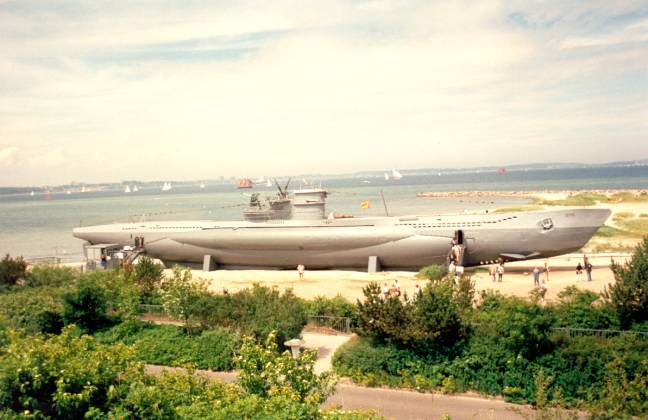
Built to fight in the Atlantic, far away from their bases, the Type V11-C submarines had a range of 9700 miles on the surface steaming at about ten knots. Underwater their range was severely curtailed, being only 130 miles at a miserly two knots, but they could dive to a maximum depth of 120 metres.
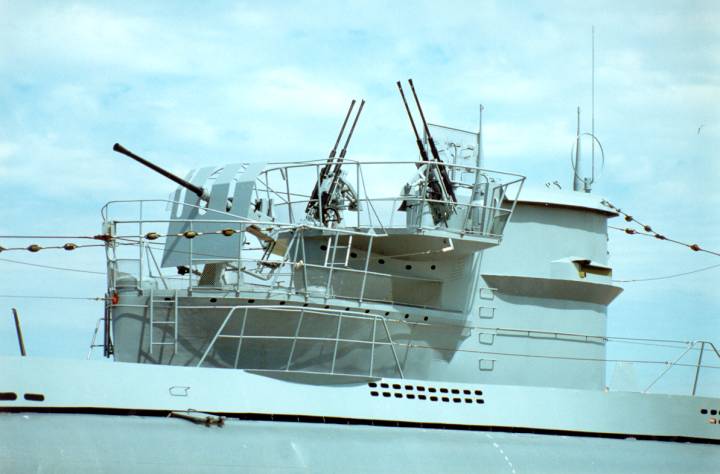
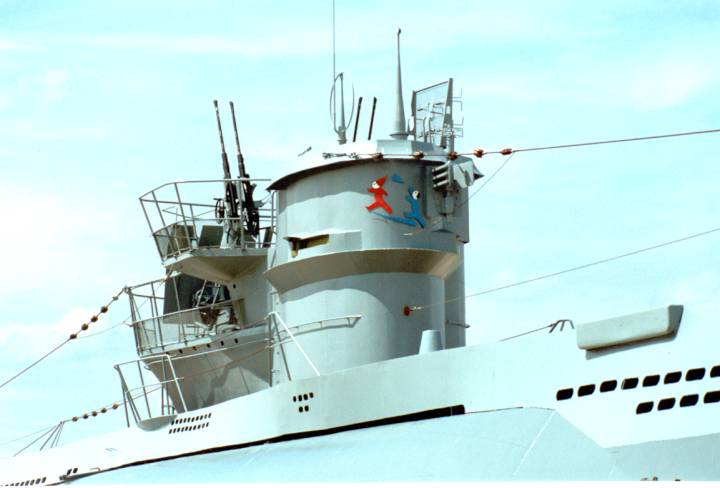
All versions were armed with five torpedo tubes, four in the bow and one in the stern. Gun armament varied, but by the end of the War most had a 88mm gun and four 20mm flak guns in a quad mounting.
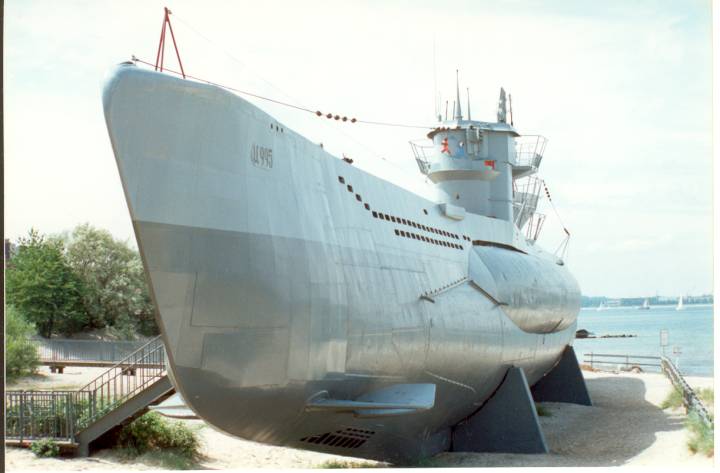
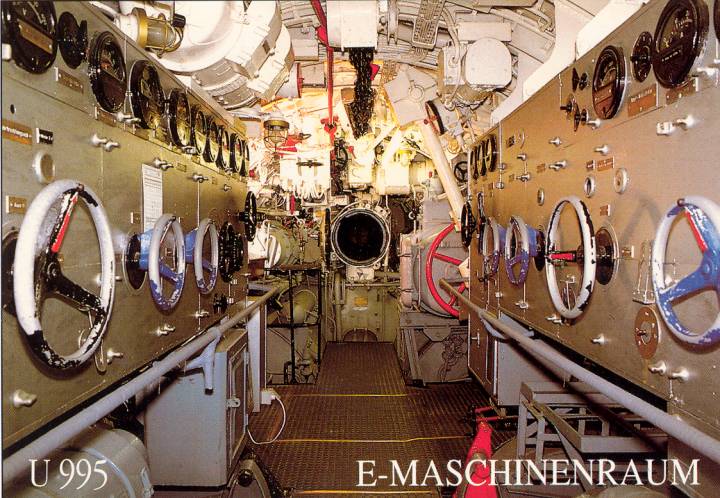
The U995 is probably the best example of this class of submarine (there is one other in Chicago) and its location in the pretty seaside town of LaBoe close to the stunning edifice of the Marine-Ehrenmal, and the moving U-Boat memorial, make the visit a delight even if you are not particularly interested in submarines.
Blorn and Voss launched the U995 on the 22 July 1943. A few days later she was badly damaged in a bombing raid and her future put into doubt. However the demands of a severely over stretched U. Boat arm demanded that all possible submarines were made ready and after a huge amount of effort, U995 was repaired and became operational on September 16th. She was assigned to the 5th Submarine Flotilla stationed at Kiel where she successfully completed her work-up.
On 25th. April 1944 U995 sailed to Norway in readiness for the suspected invasion. In the middle of May she was attacked by a Sunderland Flying boat. She lost five men in the encounter but was only slightly damaged. Once repaired she then moved to the 13th. Submarine Fleet at Trondheim.
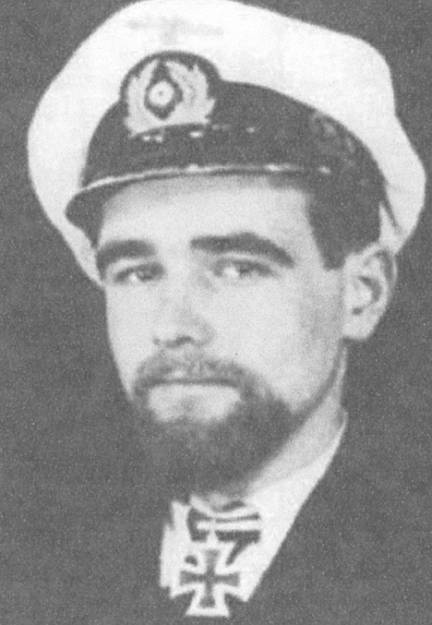
The U995 carried out nine patrols in her career, sinking four ships, one of them being the American cargo vessel Horace Bushnell. On February 8th. 1945 Kaptain Hans-George Hess earned the Knights Cross for a daring raid into Kirkenes Fjord were he torpedoed and sunk a freighter. On May 8th. 1945 the War was over and Kapitain Hess surrendered his boat at Trondheim and spent a year in a Norwegian prison camp. (He later became a lawyer in Hanover)
U995 should have been taken to England, but was in too poor a condition to make the trip so she was handed over to the Norwegian Navy as part of their War Reparations. The Norwegians completely refitted her and returned her to service on December 6th. 1952 under her new name of Kaura, Nato Fleet Number S309. Ironically it was as the Kaura that she later visited England as part of a Nato exercise. By 1962 the Kaura’s operational life was over and she was laid up.
It was then that the German Navy Association had the idea of rescuing her and putting her on display. There was some political opposition to this as in those days Germany still was not considered completely rehabilitated, and nobody wanted to give a working submarine back to a country that had been the worlds best submarine nation. In the end these fears were overcome, and in an extraordinary gesture of friendship, Norway, who had suffered terribly at the hands of the German military machine, said that they would be happy to present the submarine to the German Navy Association.
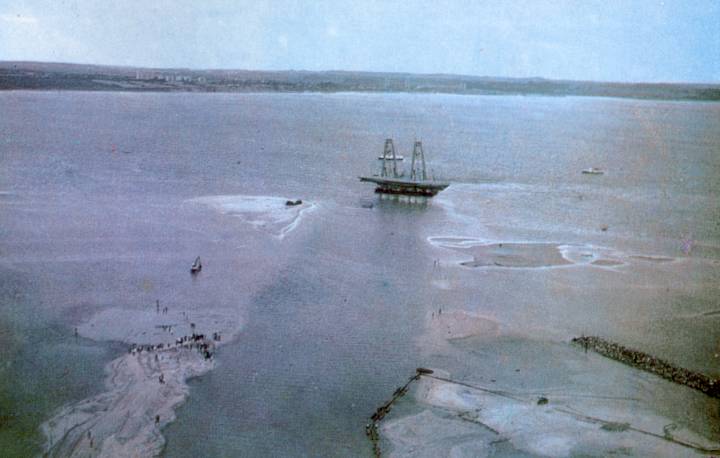
The work to turn the battered U995 into a museum took many years, but finally in 1972 all was nearly ready. The U995 was slung beneath a colossal floating crane and slowly towed through a specially dug channel to the beach just in front of the Marine-Ehrenmal memorial at LaBoe where she was lowered into a specially prepared concrete cradle. At her dedication she was visited by many great names including Donitz and Krechmeyer. I would love to know what they were thinking as they walked around this once deadly submarine.
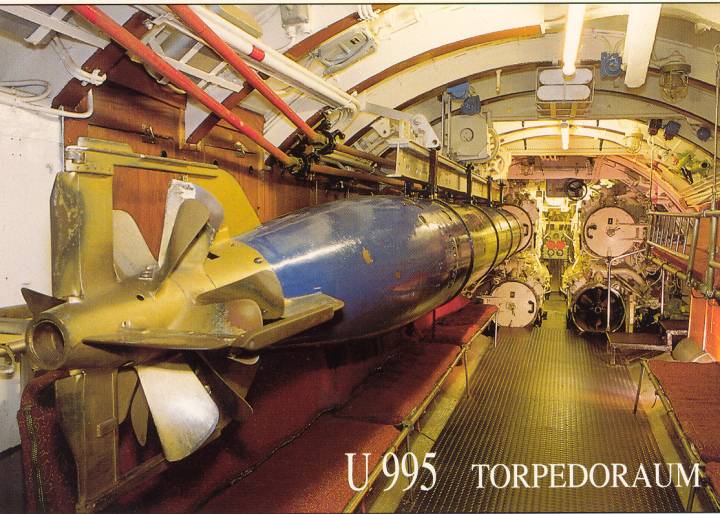
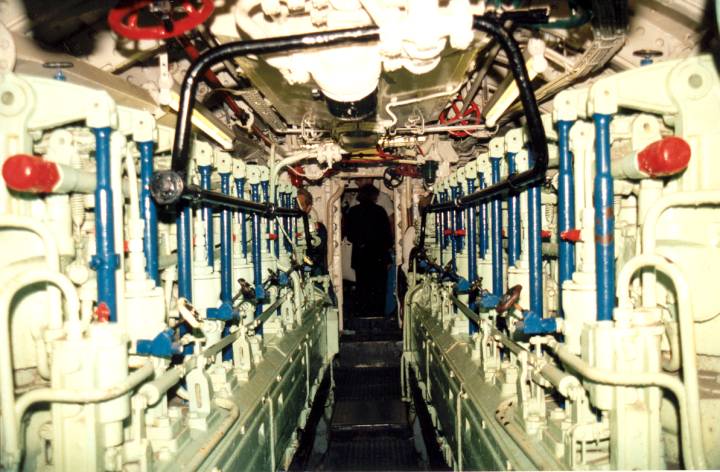
The U995 has been beautifully restored and works very well as a museum exhibit. On one level she shows exactly what a submarine was like and just how complicated and cramped they were. But on another level the U995 manages to connect with that awful past out there in the freezing Atlantic, the domain of the Wolf packs. What it must have been like to fight and die in these steel coffins is almost unimaginable in today’s world. U995 fulfils its aim of being a museum, and also a dreadful reminder of those far off days that all of us hope never to see again.
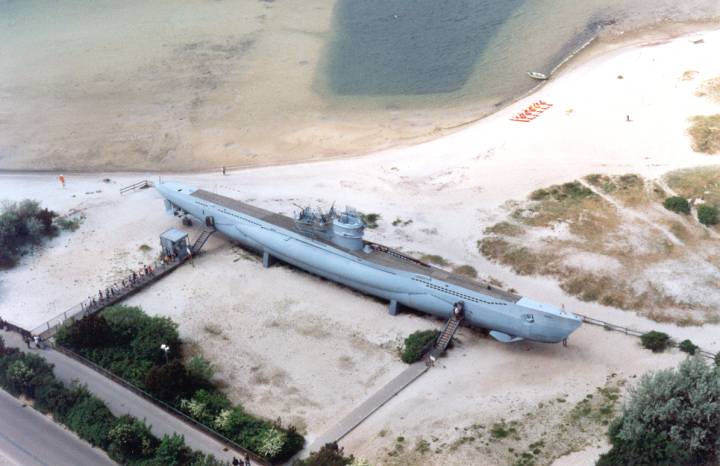
Workhorse of the Wolfpacks
Extract from The Silent Menace.dvd

Richard says
Interesting read of a famous U-boat, even if it wasn’t one of the most succesful ones.
One note however: Your narrative does not state that this U-Boat was not a standard VIIC but a improved VIIC/41 with higher crush depth and different conning tower and flak armament.
My fifty cents to an otherwise accurate and interesting read…
Richard
Calum Davidson says
Couple of points – you have the wrong country when you say she visited England as part of a Nato exercise in 1962 – in fact it was Scotland (the country where all her sisters who surrendered to the Royal Navy ended up in April and May 45).
She also visited the small Scottish town of Lerwick – in the Shetland Islands – in 1965, on her very last voyage as a military vessel, where I as a very small boy was taken aboard her for a visit (by my Dad who had spend an uncomfortable few weeks in 1945 dodging U-Boats in his aircraft carrier on route from Scotland to the far East for the war against Japan).
I remember the smells of diesel, the very cramped conditions, and the rows of sub-machine guns on the walls of the conning tower!
I had no idea that she still existed, I must try and see if I can arrange a vist next time I’m in Northern Germany.
Holly Marshall says
I don’t know if you can help me, I am trying to locate information for a close friend of mine. Her fiancee was killed on September 8th, 1943 on a German U-boat. His name for Lft. Rudolf Roloff. Do you have any idea where I would be able to find out if there are any specific memorials that might detail him personally? Any information that you may have would be really useful to us. Many thanks Holly Marshall
Steve says
Holly – I don’t know how much information you have about Lft. Roloff. From searches on the web it looks like he was on U669, which was listed as missing (in the Bay of Biscay) on 8th September 1943. This link might help:
http://www.ubootwaffe.net/crews/crews.cgi?uquery=1;boatnum=669
Although its loss is not explained there, it is given elsewhere as:
“‘U-669’ was sunk in the Bay of Biscay northwest of Cape Ortegal, Spain, by depth charges from a Canadian aircraft (RCAF-Sqn. 407). ”
That info is given here:
http://www.ww2aircraft.net/forum/ww2-general/day-war-europe-65-years-ago-6116-63.html
(message #935).
The date of the sinking is given as the 7th of September. I suppose that was when he died. Given the location, perhaps the boat was making her way back via the Spanish coastline.
Information for RCAF407 is given here:
http://en.wikipedia.org/wiki/No._407_Squadron_RCAF
Judging by the dates, it looks as though the aircraft would have been a Vickers Wellington. Actually that would have been a British aircraft crewed by a unit from the Royal Canadian Air Force, serving with RAF Coastal Command.
I regret that I do not know of any personal memorials.
mike smith says
would love to visit the u995 do you know if you have to book a tour of the u-boat ,is there a charge or is it just a donashion and what are the opening times.Thanks for any help you can provied. mike
André says
Opening times and fees are listed here (in German):
http://www.deutscher-marinebund.de/preise_zeiten_me.htm
That is 1st of November till 31rd of March from 9:30 to 16:00 daily,
1st of April till 31rd October from 09:30 to 18:00 daily.
Fees are €4 for grown ups and €2.80 for kids/students (U-boat only).
Also check out http://www.deutscher-marinebund.de/u995_geschichte_english.htm with panoramic views of control center and engine room.
Andrew Nelson says
@Mike Smith
I was on U995 on Monday 19th March and there is no booking needed just turn up at the Shop located opposite U995 and you are given a token for the gate you may also want to vivit the Laboe War Memorial an absolutely enlightning experience I would recommend to anyone.
Thomas Maher says
This may be a fine point, but U505 in Chicago is a type IX boat, which were (slightly) larger. The Chicago display is well worth it if you are in the area; it’s in the Chicago Center of Science and Industry.
steve Darlington says
Have just come back from hamburg.Visited the U995 at Laboe. I finally made a life time ambition comr true, and savoured every moment on a piece of history. The monument opposite is inspiring and a tribute to all the seamen who lost their lives. I have yet to dive a ww2 uboat , but hope to do so in the future. Dont think about going to see the u995, just go. The surrounding area is lovelly, a typicle german seaside town. Hamburg is nice as well
William E. Brown says
In 1979 I was a US ARMY motor sergeant with the 1/59th ADA in support of annual vulcan gunnery practice. Where we were was a short walk from the U-995 and I spent many hours aboard this U – Boat, I have always been fascinated by submarines and I enjoyed this museum so much that I wondered from one end to the other for several hours . It’s certainly intriguing to me how cramped and uncomfortable it had to have been for 54 men to fight and survive for weeks at a time on one of these subs . If I ever get the chance i’m going to tour the one in Chicago.
tom colclough says
Took my father following a invitation visit to this exhibit -he was one of the crew members of coastal command aircraft which attacked this submarine U995 -he met with crew who served on board they spent time recollecting and enjoyed each others company he left his RAF QC card which was displayed on the radio rood window of the vessel
Matthias Moratzky says
To:
Holly Marshall says
September 30, 2010 at 7:42 pm
———————————————————————————————————
Dear Holly,
This is a website I found:
You can search for any name/ person there:
I just tried Rohloff and got this reply:
https://historisches-marinearchiv.de/projekte/crewlisten/ww2/eingabe.php?active_cl2=result
Roloff, Rudolf Lt.z.S. 28.02.1923 00.09.1943 Bay of Biscay U 669+ missing
You could send them an email, to this institution, to ask them for further information ..
Or ask them where to get better information, if there exists any ..
kind regards
Matthias
jose santos arribas alonso says
soy de chile y admirador de la marina alemana // observar este submarino da cuenta de la avanzada tecnologia que tenian estos marinos.. a su disposicion //luego uno piensa en los marinos que navegaron en pLENA GUERRA Y SE HACE MUCHAS PREGUNTAS…. que tensiones y temores deben haber tenido de ser muertos al interior de esta estrecha nave // me parece excelente el buen cuidado que se tiene en esta nave- museo // gracias
Earline Nairn says
My brother-in – built a replica of the U995 a t his home in Nova Scotia. It was 33 feet in length. Upon his death my husband and I donated it to the navy who finished it. The u- boat was on display at the new submarine school opening in June 2003. The navy later donated it to the Quebec naval museum. I sent them all the pictures showing the construction. Where it was on display. The u-boat was on a cruise ship in the Saint Lawrence river for the 250 anniversary of Quebec City. Only 7 people knew or saw the u-boat while it was being built. My brother-in-law corresponded with Kaptain Hess when he was working on the u-boat
.