
Experience with earlier types of destroyers had convinced the Navy that going just for speed was a delusion. What they really needed was a much tougher type of boat that could keep going at relatively high speeds when the weather got really rough. To this end the Navy commissioned a new type of destroyer that was to provide the bench marks for all future Navies, and designated it the River Class. Well over thirty were built before the Great War, and one of them was HMS Foyle.
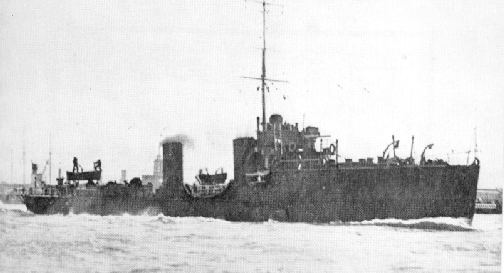
Laid down at Cammel Lairds shipyard in August 1902, the Foyle was launched in February of the following year and entered service thirteen months later in 1904. 225 feet long with a top speed of twenty five and a half knots, the Foyle was armed with four twelve pounder guns and two torpedo tubes. At first her slower speed (anything under thirty knots was considered very odd) caused some ill informed comment, but it was soon realised that the sturdiness of her design allowed her to maintain her top speed in all but the worst conditions, and soon her critics were silenced.
When War broke out the Foyle found herself performing patrol and escort duties in the killing ground of the Dover Straights. On the night of March 15th 1917 she hit a mine, and the force of the explosion blew away the whole of her bows forward of the bridge, killing twenty-seven of her crew of seventy. Unbelievably the stern half stayed afloat, and it was decided to tow this to Plymouth, presumably to graft on another bow. What the thoughts were of the tug crews who had to place the tow on a helpless drifting hulk in the middle of a potential minefield we can only guess, but eventually the tow was established and the Foyle was led away towards Plymouth. Alas there was to no happy ending. After surviving the minefield and slipping through a screen of marauding E boats, the salvage crew on the Foyle just could not keep up with the water pouring through her ruptured plates, and only a few miles from Plymouth HMS Foyle gave up the fight and sank in fifty meters of water miles off the Mewstone.
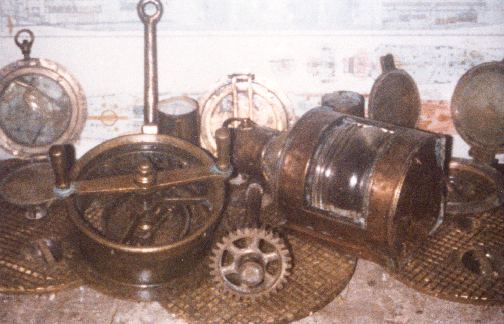
One of the main troubles about diving on a wreck as deep as the Foyle is the lack of time that you can spend on her. If you are diving this wreck on a one off basis, then you really will not have a clue where you are on it unless you stumble onto the gun at the stern section, or blunder into the bridge. You really need to go with somebody who knows the wreck so that they can explain to you after the dive where you have been, or pray for uncharacteristically good visibility. Having said that, the one thing that anyone will recognise is the brass. On the few dives that I have done on this wreck everywhere that I have looked there seemed to be large lumps of non ferrous metal, either portholes (to firmly fixed for me) large copper pipes and brass valves, or on one occasion, what seemed to be the top of a binnacle.
The Foyle now lies on a sandy seabed with what appears to be a thirty-degree list. Most of the portside is buried in the sand and the rest of the hull has caved in. However her boilers seem to be mostly intact, although other divers say that one boiler is probably buried in the wreckage. At the bridge end is a great mound of iron plates and girders covered in shoals of swirling pollack and pounting. Somewhere in all that junk should be three of the Foyles twelve pounder guns, but I must confess I have never seen them. Lobsters abound on the wreck as do congers, and because the wreck is heavily fished by local anglers quite a bit of fishing gear is left lurking to entangle the unwary diver.
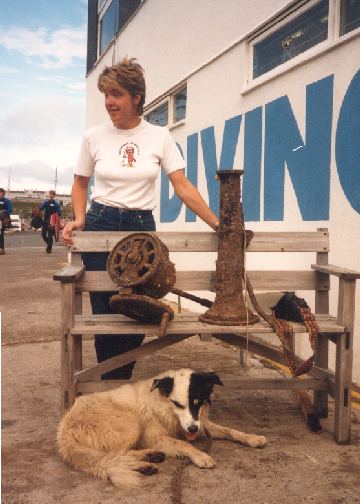
Somewhere towards the stern are the remains of the torpedo tubes. Back in the Sixties rumour has it that one of the Foyles torpedo tubes still had a torpedo left in it. When this torpedo was duly liberated and placed on dry land, the salvers became so blinkered as to the profit on the non ferrous metal, that they seemed to completely forget all about the couple of hundred pounds of Amatol explosive that was by now highly unstable.
When the Police arrived on the scene they found the scrappers gaily hacking at the torpedo with lump hammers and crowbars, with the explosive oozing out of the cracks that they had made. Seems unbelievable doesn’t it? But as I say it is only a rumour.
The Foyle is probably the deepest wreck off Plymouth that you can still find just on the marks. But because she only stands up about fifteen feet from the seabed, and is such a long way down, a good echo sounder is really a necessity. Once you have found her you will be able to fine-tune the marks to suit your boat handling techniques, and then you should have no further trouble. If you can arrange a series of dives on the Foyle, so much the better as it is very frustrating to see something that you cannot get off in the short time available. In recent years local clubs have had some very impressive trophies from this wreck, but for the dedicated wrecker there is still an awful lot left.
I am extremely gratefull to Russel Peekfor this photo of his great grandfather Samuel Peek, who was a stoker on H.M.S.Foyle. Sadly he did not survive her sinking.
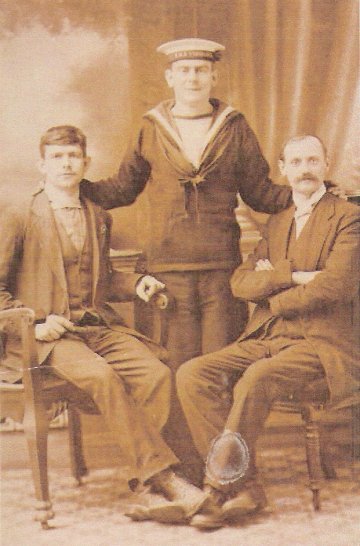
I am very grateful to Mark Lawrence for the photo and information below.
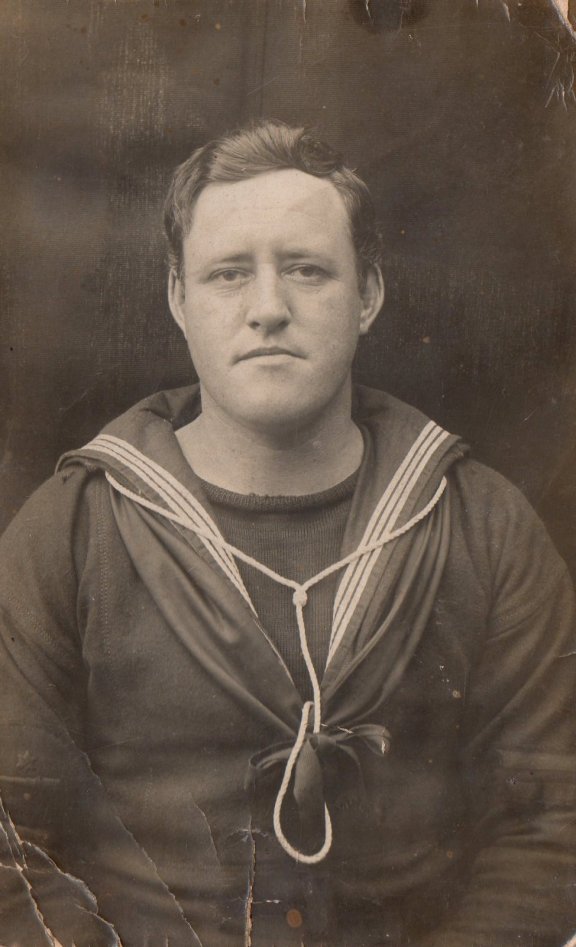
Able Seaman George Arthur Gander -191637- was serving aboard HMS Foyle, when she hit the mine. His body was not recovered. His wife Rose of Gillingham, Kent was notified of his death. He was born in Brighton in 1881.
I am very grateful to Tony Game for the photo, and information about his Grandfather, James Alfred Alexander Game.(He writes) I don’t have a photo of Granddad as a young man, but this is the last known photo of him at the christening of his great granddaughter in the summer of 1970. Along side him is his eldest Grandson Larry James Game 1941-1989. This is also the day that granddad died 1895-1970.


ALLISON, James S, Signalman, RNVR, Clyde Z 2892 ARCHER, Ernest, Petty Officer, J 8776 (Ch) ARNOLD, James, Stoker 2c, K 39076 (Ch) BENNETT, John W, Signalman, 222683 (Dev) BIGSBY, Albert E V, Stoker 2c, K 39200 (Ch) BLOWES, Frank, Stoker 2c, K 39054 (Ch) BUTLER, Arthur W, Stoker 1c, K 25143 (Ch) COATES, Frederick J, Able Seaman, 238829 (Dev) COLE, Harold G, Stoker 1c, K 22752 (Ch) CRITTENDEN, Howard G, Stoker 2c, K 39087 (Ch) DANES, Albert V, Leading Stoker, K 15907 (Ch) DAVIS, Alexander, Stoker 1c, K 26058 (Ch) DAVIS, John H, Stoker 1c, K 17087 (Ch) GANDER, George A, Able Seaman (RFR B 8057), 191637 (Ch) GOATHAM, Augustus, Leading Stoker, 295977 (Ch) HARRIS, Bert, Leading Stoker, K 11503 (Ch) HATFIELD, John I, Boy Telegraphist, J 48937 HERBERT, James J, Leading Seaman, 227334 (Ch) HULFORD, Sidney A, Stoker 1c, SS 115470 (Ch) MCDONNELL, George F, Fireman, MMR, 905338 MCKEOWN, Eugene G, Act/Engine Room Artificer 4c, M 18497 (Ch) MIDDLETON, James W, Stoker 1c, SS 115383 (Ch) PEARSON, John A, Able Seaman, J 29658 (Ch) PEEK, Samuel, Stoker 1c, 230201 (Ch) RICKARBY, Arthur J, Able Seaman, J 29663 (Ch) ROAKE, Arthur, Able Seaman (RFR B 8843), SS 1940 (Ch) RUSSELL, Alfred, Act/Engine Room Artificer 4c, M 19746 (Ch) SMITH, Henry G, Able Seaman (RFR B 5534), SS 342 (Ch) STEARN, Sydney J, Leading Signalman, 194902 (Ch) WOODLEY, Edward A, Ordinary Seaman, RNCVR, VR 2688
I am very grateful to Roger Dingley for all the information and photo’s below about his uncle Alf Russell.There is also a sound bite of Roger’s mother, Edna Dingley talking about Alf.


Below is the citation issued by the Navy on his death. This gives the dater on his birth and death. The Census records for 1911 indicate that he was living in Harborne with his parents, but working as a screw turner. He was a trained engineer which probably made him a natural to go into the Navy as an ERA, but we have no record of his training, or exactly when he joined.
Name: Alfred Russell Rank: Act ERA 4th Birth Date: 24 May 1890 Birth Place: Great Wyrley, Stafford, England Branch of Service: Royal Navy Cause of Death: Killed or died as a direct result of enemy action Official Number Port Division: M.19746. (Ch) Death Date: 15 Mar 1917 Ship or Unit: HMS Foyle Location of Grave: Not recorded Name and Address of Cemetery: Body Not Recovered For Burial Relatives Notified and Address: Mother: Carrie. 10 Margaret Grove Harborne, Birmingham

J Turnbull says
Ref: Public Records Office ADM 137/389. FOYLE was patrolling in the Western Channel when damaged, hence her tow to Plymouth. If she had been in the Dover Straits (note spelling) she would not have been towed all the way to Plymouth. She sank in 50 metres of water (in English, meters measure Amps, Volts etc.)
Otherwise an interesting site. Keep up the good work!
Rienk Halsema says
Wie heeft er foto’s voor mij van de H.M.S.Foyle?
Zelf ben ik in het bezit van de scheepsbel en zou graag wat foto’s van dit schip willen hebben.
Jim Foyle says
Very interesting information but there was no mention of who the HMS Foyle was named after, any comments?
Peter Mitchell says
Foyle is a River class boat. the river Foyle is in Northern ireland
terry hillis says
Found your article interesting.My father served on the Foyle a River class destroyer.I have a “Shiffs-Messbrief” which I think is the specification of German Schooner which whilst laying mines was engaged & sunk by the Foyle off the Isle of Sky on 4th Jan 1915.If anyone can throw any light on this subject I would be interested but please send any emails to my personal address although I have no objection to it being opied to this website.Many thanks.Terry Hillis
billy says
just been fishing over hms foyle
H. Hyde says
Re HMS Foyle. Recently there was an enquiry on this site concerning a crew member, AB HG SMITH, who was killed when the ship was mined in 1917. Could anyone supply the name and Email address of the enquirer? Thanks
Rosemary Woollard says
I am looking for a john turnbull, not sure if this is the right one, did you used to live in south norwood?
Maeve Roberts says
Dear Peter and readers,
I hope you won’t mind me posting a quick enquiry here. I’m currently finishing an MSc course (Hydrographic survey) at Plymouth University and I’m planning on surveying the Foyle as part of my disseration. This will include ROV video footage, sidescan and other acoustic data, as well as collecting as much extant Admiralty detail (Home Waters telegrams, the court martial detail, etc. etc.) as possible from Kew (TNA). I’m more than willing to make all of this available to anyone interested, and wonder whether anybody has any information that may help build a comprehensive pitcure of the wreck – any artefacts recovered, pictures, accounts, dive notes, family records – anything! It would be nice to get as much recorded as possible, and if anyone is able to help, that would be great.
Many thanks,
Maeve
David Lee says
Just been doing some family research on the web.Found my uncle on the 1911 census website.
Leading Stoker Joseph Lee Aged 21, serving on HMS Foyle at anchor in Grimsby Roads.
Mark Lawrence says
I have a photograph of a distant relative: Able Seaman George Arthur Gander -191637- who killed when HMS Foyle was hit.
Kerry says
I also have an ancestor who died on this ship. His name was Harold Cole, he was on board when the ship hit the mine and his body was never recovered.
Is there a website that lists crew on board that night?
David Bird says
Dear Kerry,
In researching details of one of the members of our church listed on our WW1 War memorial, Alfred Russell – who sadly died aboard HMS Foyle on 15th March 1917, I came across the website http://www.naval-history.net. If you follow the site to that date you will find listed all the 28 officers and men who were killed aboard this vessel. You ancestor is listed there:
COLE, Harold G, Stoker 1c, K 22752 (Ch)
“We will remember them!”
Rob Bevan says
My Great Uncle, K/17087 Stoker 1st Class, John Hughes Davis,aged 22 was one of the 28 members who died on HMS Foyle,15/3/1917. How very sad.
Tony Game says
While researching my Granddad I found that he was on HMS Foyle on the 15 March 1917 when it was sunk. James Alfred Alexander Game K25280, he lived on and served until 1926. Trade Stoker.
Marion Cole says
My great uncle, Harold Cole, was killed on HMS Foyle. I see Kerry’s email of 18 June 2014. If you are out there Kerry it would be good to get in touch as we must be related.
Anita Allsopp says
My great uncle, James Arnold, Stoker 2nd class was killed on HMS Foyle. Does anyone have any group photos of her crew please?
Roger Dingley says
Just found your website re HMS Foyle.. My uncle (Mother’s brother) was Alf Russell an Engine Room Artificer and a wonderful man by all accounts. I have several photographs of him including one with a friend who could be from the ship.
He was a skilled engineer and I have still got some if his tools such as micrometers and prescision gauges. He also made a scale model of a whaling boat which I have.
Let me know your email address and I will send copies of pictures.
David Garfield says
My maternal Grandfather, Spencer Dennis, survived the sinking of HMS Foyle. I was six years old when he died, so I knew nothing of the incident until much later. As with many such wartime occurrences, it wasn’t mentioned casually, and the story came to me in somewhat garbled fashion — seemingly quite inaccurately. I’m in the process of learning as much as I can about his experience in the service.
Granddad had already fathered four children by the time of the incident but, had he perished, the last of his progeny and additional descendants would not be here.
David says
I have a newspaper article placed by the family for the death of Able Seamn CJ Rowell when his ship hit a mine and sank on 15 March 1917.
Only the Foyle appears to have been sunk on this date and in this manner, but CJ Rowell does not appear in the official death records.
His RM papers abruptly stop on 2 March 1917, not discharged dead or anything else for that matter so it is somewhat of a mystery.
CJ Rowell is commemorated on our War Memorial.
Any suggestions/ideas ?
Pam Dunne says
My great uncle, John William BENNETT, 222683 (Dev) Signalman also perished on HMS Foyle on the night of 15 March 1917. Any information/photographs of the crew would be so greatly appreciated.
William D T Davis says
Hi! Very interesting. John Hughes Davis is my grandfather Ernie’s cousin: I have a photograph of him in uniform with a shipmates taken in a studio during the Great War.
Kellie Finch says
Hi came across this website whilst research my family history as John Hughes Davis Stocker 1c was my great Uncle, his was the brother of my Nan Lily Elizabeth Chapman (nee Davis). From information from my Nan John was the best friend of her future husband John Arthur Chapman who was also a stoker in the Royal Navy.
William D T Davis would love to see the photograph of John and his shipmates, and Rob Bevan would be interested to know who you parents are as one would have been either my Nans brother or sister.
Thank you for the information about the ship.
Foulmouth says
https://www.facebook.com/commerce/listing/5127920663963519/?media_id=0&ref=share_attachment
Porthole for sale – not mine.