
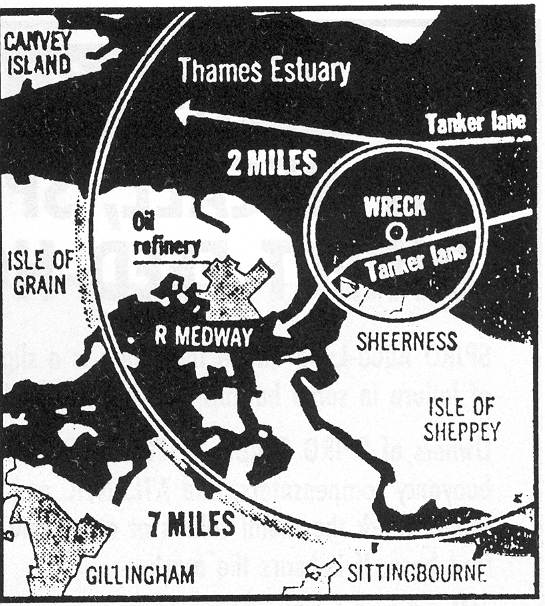
Tucked away in the south east corner of England is the seaside town of Sheerness. On the surface you would think that Sheerness was just another pleasant holiday town, and you would be right, because you would have to go underneath the surface to a spot some three thousand yards off the seafront to find the dangerous secret that Sheer- ness has harboured for over forty years. A secret that although buried In sand and silt sixty feet down within the rusting hull of a World War 2 Liberty ship, Is so potentially hazardous that nothing is allowed nearer than five hundred feet.
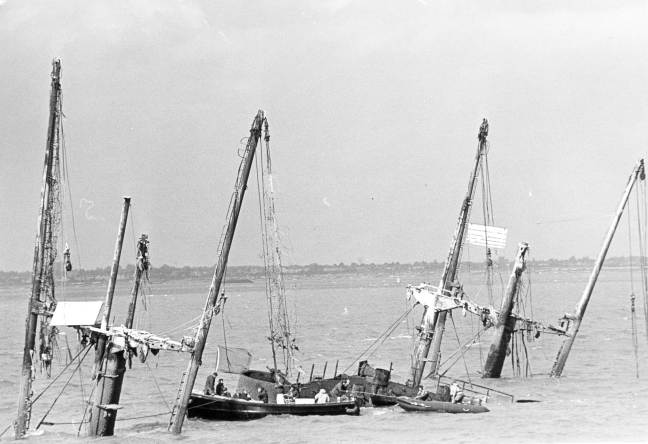
When that Liberty ship , the Richard Montgomery, sank all those years ago it contained over seven thousand tons of explosives, enough to blow Sheerness and all its neighbours sky high, and In credibly its still all there like some giant time bomb ticking relentlessly away. The trouble is that nobody can seem to agree whether the clock has stopped, or is just about ready to strike. With today’s attitudes on all things ‘green’ it seems absurd that the Montgomery’s cargo was not made safe years ago, but absurdity and incompetence often go hand in hand, and incompetence certainly seems to have been the hallmark of this story right from the start.
The Richard Montgomery started life as the seventh ship in a production line of eighty two Liberty ships built by the St John’s River Shipbuilding Company in Jacksonville, Florida, and was launched in July 1943. She was named after an Irish soldier, who after getting himself elected to the American Congress fought in the war against the British in Canada and was killed in the final assault on Quebec In 1775. Only a year after her launch In August 1944, the Richard Montgomery, on what was to be her final voyage loaded up with over seven thousand tons of bombs and munitions at Hog Island, Philadelphia and slipped quietly from the Delaware River and crossed the Atlantic to the Thames Estuary where she was to await a convoy for Cherbourg. At Southend she came under the orders of the Thames Naval Control and the Kings Harbour Master ordered her to anchor in a berth just off the north edge of the Sheerness Middle Sand. Considering the fact at low water there was only about thirty foot of water atthisanchorage and the Richard Montgomery drew just over thirty one feet, it was fairly obvious that the Kings Harbour Master had made a grave error of judgement. So obvious was this that the Assistant Harbour Master refused to carry out the order unless it was put in writing.
A noisy argument ensued which attracted their superior officer who sided with the . Kings Harbour Master and told him to confirm the order. The Assistant stormed out and was posted to another position two days later. Significantly his evidence was not heard at the resulting board of enquiry which did not even mention the difference of opinion. Early on Sunday morning, August 20, lookouts on the ships anchored near the Richard Montgomery saw her swinging towards the shoal as the tide flowed in and frantically sounded their sirens in warning. The Chief Officer who was on watch did nothing to save his ship, not even bothering to wake his Captain who was peacefully asleep in his cabin. Soon the tide pushed the Liberty ship right onto the top of the Sheerness Middle Sand where she became completely I stranded. As the tide ebbed the ship settled down more firmly on her silty bed and buckled some of her plates, causing them to emit cracking noises that sounded like loud gunshots. The crew. not unnaturally apprehensive about their cargo suddenly decided that they all wanted to be landlubbers and deserted the ship in a flurry of lifeboats and rafts. Since the Montgomery had stranded on a neap tide she could not be refloated for about two weeks, and even then only if most of her cargo was removed.
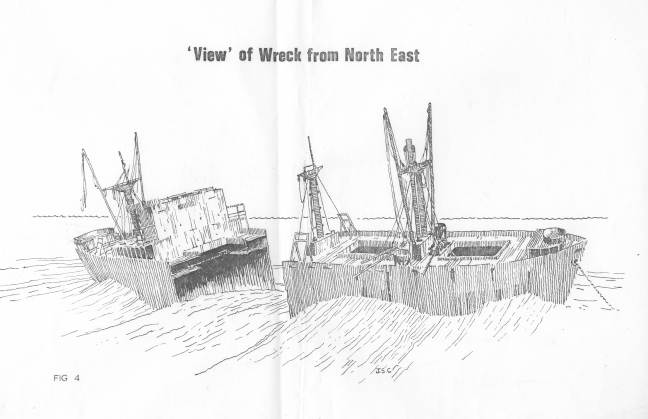
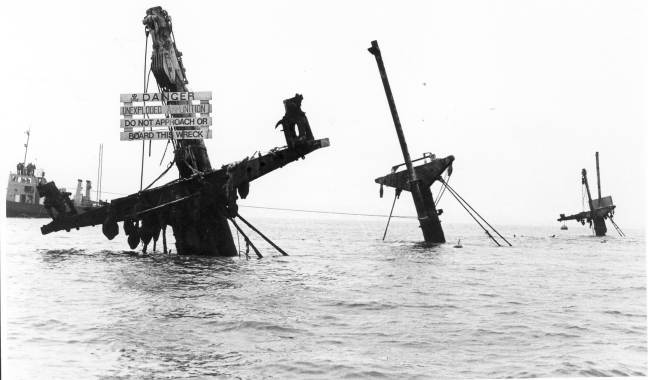
Immediately an emergency operation was put together and the next morning unloading started using the ships own cargo handling equipment which was still intact. At this stage there was liffie damage to the ship and all the cargo hatches were still securely in place. Twenty four hours later however. disaster finally struck when the strain on the hull became too much and it cracked like an eggshell at the front end of No 3 hold. Flooding quickly swept though No 1 and No 2 holds. and early the next day the Richard Montgomery completely broke her back. Salvage continued until all of No 4 and No 5 holds. which were still above water. were emptied. The unloading was aban- doned when it became obvious that the ship was now a total loss. Decaying, unstable explosives With the war reaching its final crescendo there were plenty of other ships that needed attention and the Richard Montgomery was deserted In the fond hope that ‘somebody’ would do something later on after the war was over. But nobody ever did, and the remaining cargo, some three and a half thousand tons of decaying unstable explosive Is still there today buried in her hull.
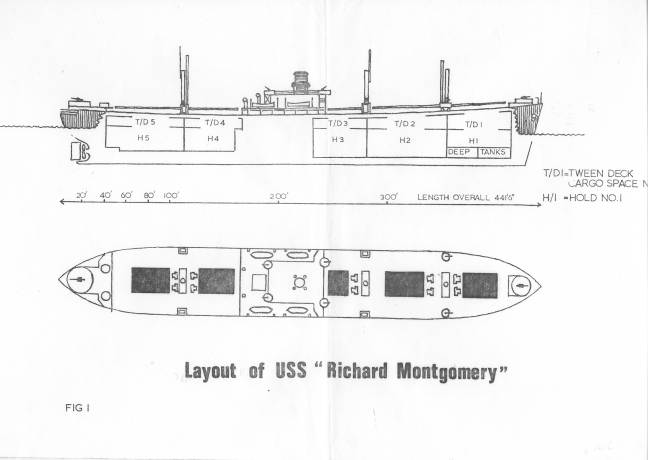
So what are the risks? Well most people agree that If the Richard Montgomery blew up, it would be the largest non-nuclear explosion in history. Would Sheerness and the nearby oil refinery on the Isle of Grain be swamped by a huge tidal wave, or engulfed by an awesome fireball as some experts have predicted? Would terrorists use the terrifying potential of the ship to hold the Government to ransom by threatening to eradicate the population of a small town as some journalists have suggested? Or has the vessel’s cargo now decayed to a point where it has become a minimal risk as various Government surveys have suggested? Curiously the answer lies in a mix of all these. Of the three and a half thousand tons of explosives left, most contain TNT and are impervious to seawater. It is highly probable that their fuses have long since deteriorated and would therefore need something else to set them off. Unfortunately on the deck above these are approximately one hundred and seventy five tons of fragmentation cluster bombs fully armed and ready to go. These are considered to be the main danger, because if the decking collapses these bombs could fall on top of the others and set the whole thing off.
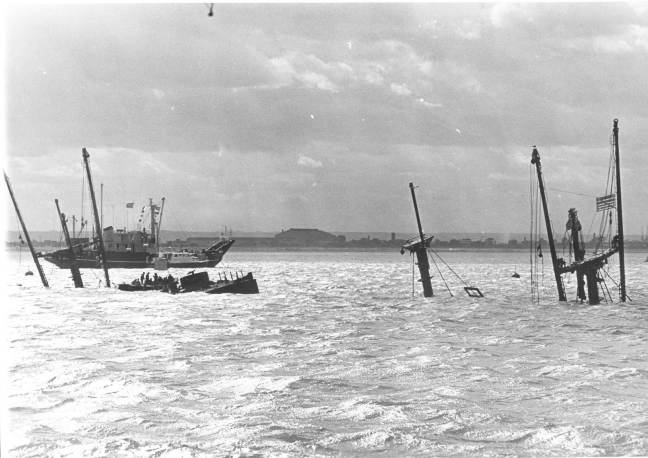
This is not as far fetched as It might seem, Already the ship is broken into three pieces and In 1980, after an underwater survey Norman Tebbitt, then Minister of State for Trade said that the ” risks of removing bombs from the stricken wreck were unacceptable.” This statement supports the view taken way back in 1948, and later in 1967 when the American Government, still nominally the owners of the vessel, offered to make the Montgomery’s cargo safe, The Government of the day refused point blank on the grounds that it was too dangerous and that the bombs would get ‘safer’ the longer they were left alone.
In August 1981 a thorough under- water survey was carried out by Navy divers, including going right into the holds containing the bombs After nearly a month their verdict was that although the bombs were still potentially dangerous, it would be safe to remove them from the ship. Said Des Bloy, Moorings and Salvage Officer at Chatham, “it would take one hell of a detonation to make that ship blow up”.Apart from malicious or terrorist action, one of the most likely causes of detonation are the huge amount of ships that pass daily close to the wreck.
Over the years twenty four near misses have been recorded, and once a cargo vessel actually hit the wreck knocking down one of her guns and demolishing a ventilator. What the consequences of a large passenger ferry hitting the wreck would be God only knows, but repeated appeals to the Authorities for a solution have come up against a stone wall of indifference and worries about the cost of a safety operation. So there the Richard Montgomery lies, gently rusting away, probably safe, but still a huge potential threat to the communities that surround her. As one Sheerness councillor bitterly said, “If this boat had gone down outside the Houses of Parliament, something would have been done long ago. How far down the river do you have to go before a dangerous wreck becomes acceptable?”

lizzie simpson says
How could people think that it should be destroyed..this is the islands only historic fetaure that no one has touched or messed around with yet..it ios facinating to know that years ago..there was people on this ship and it was floating across our waters.. If i was able to go and see this ship i would 100% because i think the site of it is absaloutley beautiful. im on 14 and i think more about this thn anything else.. people think what yhur doing before yhu go n do them..this is our history no one elses … this is what makes sheerness, sheerness .. dont destroy that … thankyou for listening x
pat says
My childhood annual holidays were spent at Sheerness (1950’s) where my nan lived at 1 Unity Street. We always took a trip round the old Wreck and heard many scary stories, like it could easily explode. This article made very interesting reading.
Dave Hopper says
Having spent many years doing commodores cruises around the SS Montgomery it would be a shame for it to be removed, touched or disarmed.. Some of its beauty and intrigue is it’s danger. i have been lucky enough to have been able to be closer than most to this ship and would emplore anybody that goes close to leave it well alone.. you will ruin something that does not need to be touched..
carl sparks says
hi i live in gravesend in kent in the summer when the tide is out some times you can see the deck she dose look good why should people muck a round with ships like this like you say its our history and no one elses so leave it a lone i often go and sit there on the beach just to see her
Roxy says
My Grandad was working there that night and he took the message.
I go there and think wow thats some nice history,She was a lovely ship tho,You can tell when the tide is out.
henry brough says
As a child i use to go to sheerness in the summer to visit my gran she use to live at 51 clyde street sheerness as a boy i use to walk to the sea front and watch the ships go by the old wreck as we called it was the thing that even as a small boy got your sight my dad use to take me on the boat that use to do trips round the wreck,, earler this year i went back after close to 40 years to look around sheerness to see what i could remember and was glad to see the wreck was still there,,,, there is now not as much above the water as when i was a boy and it has a lot of markers around it ,, some things change like a large tesco but others like the wreck are much the same,,…
regards
henry
tiaa. says
im doing a school project on this, i think it really is fascinating to think at any time it could just blow up the hole island and it’s so historical that it is still after all this time!
robert from holland says
wow i remember this site….sitting on the Olau ferry in the 80’s…..cool!
Ellie Jordan says
I enjoy going the Sheerness to view the wreck of the Richard Montgomery. I find this historical memory amazing. Ellie aged 8.
Clive Lane says
On balance, I think it should be either encased or left alone. Things only tend to explode once – obviously – but each solution is equally bad. The act of encasing the vessel, could bring about the total collapse of the remaining structure. And if the cluster bombs detonate………. Leaving it alone could bring about the same result.
When anther
Anyone for a deepwater harbour??? ammunition ship was being salvaged, it blew up!
Denva Ingram says
I agree that it is a good bit of history for Sheppey, but because the ship is under the water no one can actulli tell when this thing is going to blow up, or if it will ever. But I live about 200 yards away from Sheerness beach. It scares me to thing about it, thousands of people will die on Sheppey alone.
I done a school report of this when I was at Danley, and we had to watch a video about this, the video stated that if this ship was to blow then it will take most of Swale (Sheppey, Sittingbourne & Faversham) with it and will also affect Grain and Medway, and some even said that will travel up the River Thames and cause flooding on the outskirts of London’s Gateway.
I think that the Government should do annual checks on the ship, because they are playing with lives here, from new borns to the old.
paul bromley says
this is probably the reason the Thames barrier was built
Glyn Morgan says
I used to go to queenborough ant stay with my brother in chalk road for the school summer holidays.I took many trips around it from the beach in sheerness.My brother was a diver in Sheerness and Chatham dockyards and he dived on it inspecting the hull a couple of times.
stephen hall says
it would be a brilliant idea to build a strong retaining wall around the wreck as ships these days are getting bigger and bigger and some guided by computers. one day one of these computers could go wrong and that ship could being going in the wrong direction then before you know it it would be too late. If money can be wasted on building things like the millenium dome and even the new port at shell haven in essex, why cant money be spent making our water way a lot safer.
Charlotte says
All those who say keep the ship cause it is apart of Sheppy’s heritage or that it would be a fantastic explosion to see are mental. If those bombs exploded and thousands died would you still be saying it then? I think if anything could be done to safely remove or disarm those bombs then it should be done!!!! And when nothing is done and it does explode I reakon all the government would have to say about it is that it was a tremendous tradegy that they will not allow to happen again lol. Even though they are allowing it to happen by not keeping anual checks and thinking up ways to get rid of it. If we all die because the ship explodes I hope everyone blaims the government cause it is there job to keep this country safe and by keeping this ship full of bombs they are not doing there job properly!!!!
Roy says
I think the Americans should come and take there problem back to the states. its not a part of sheerness history. its an American shipwreck which only happened because a bloke decided to park it on a sand bank. And this only happened because they had to hide from Germans.
Mel says
The other interesting thing about Sheppey is Minster cliffs. Have they crumbled into the sea yet?
Peter Kenrick says
Since the wreck has been untouched for years, we can safely assume that there are no high-ranking polititians, etc, living at Sheerness??
Steve Hartland says
If a WW2 bomb is found homes are evacuated for blocks around.
The Richard Montgomery is located only 1.5 miles from Sheerness and 5 miles from Southend and a time bomb, on deck are fused and ready to go cluster bombs if some were to fall though the corroding deck detonating the 3,173 tons of munitions stowed inside her holds the death toll could be in the thousands.
The Maritime and Coastguard Agency convened with local and port authorities to discuss the report and in 2001 concluded that “doing nothing was not an option for much longer.”
The government says its safe but there’s have been a number of near misses with at least one vessel actually striking The Montgomery knocking down one of her guns and causing further damage to the ship.
Technology now exists to construct a temporary ‘dry harbour ‘ structure around The Montgomery (she only in 35 ft low water) and remove the explosives without the impediment of performing an underwater operation. The wreck is only monitored visually and by radar, considering the modern political climate, recent terrorist activity and the current threat level there is nothing to physically prevent a speedboat dropping explosive charges onto the wreck with perhaps time delay triggering the lot.
Why are we leaving people at risk if this had happened further up the river nearer the Houses of Parliament I’m sure funds would have been found long ago?
helen says
thinking on this,,not that its been added to for a year,,,
an underwater silt covered expolsion of the small amount of bombs left would not be as bad as people make out,,,some seafront homes may get a bit wet and a large amont of broken windows and almost certainly no loss of life ,,,unless a hart attack from the noise,,,would happen .
in no way will it be the largest non nuk explosion,,,,see google for “raf fauld” now that was big and still could be.
http://en.wikipedia.org/wiki/RAF_Fauld_explosion
i agree it needs to be delt with before its to late but you know what politics are like in the uk.
Helen..
carl sparks says
hi mark i live in gravesend in kent i go down to the isle of grain to the end by the river and walk to wards the ship it will get clearer it is nice to look at when the tide is out you can just see the deak
carl sparks says
hi helen yes i know that but the old girl is at rest now like every one say,s yes a time bomb wait,in to go off they say it is safe but i don,t think so i am going down there some time next mouth to see the old girl i try to get some pics
matthew smith says
i hope the wreck is being monoterd the whole sea bed of the thames is changing and many sand banks are eroding fast due to dredging for the new port
carl sparks says
hi matthew i was down the isle off grain to day every time i see this cargo boat i just think to my self if if it just went up what it could do to every think. the masks are about 5 feet out of the water when the tide is in that is just a guss
Dawn Ball says
I have spent many a Summer in Sheerness, staying with an Aunt, infact I still visit now. As a child I went out on a boat trip to the wreck. It was facinating and still is. I’ve heard so many stories about the wreak exploding and blowing up the whole of the Isle.
The SS Richard Montgomery is history and testiment in some way to the brave souls who fought and died in the war and of course any that perished as she sank.
jake prune says
they are going to build a museum on it
Luke Barnard says
Believe me or not but my uncle was the one that kept this boat from exploding at the time he removed a lot of explosives single handedly his name is in the official book honouring him
Matt Scales says
Hi, great to read all your comments, I live in Southend and have always been fascinated by the Montgomery, just those eerie 3 masts sticking up out of the water, you can see them very clearly from here! I was recently in Sheerness and had to have a look from that side. To be honest I was actually quite alarmed to see for myself how close the wreck is to the Sheerness shoreline!! When the tide is out how close can you actually get to the wreck?, can I take my dog out there?! In the summer I regularly take my dog out to the Mulberry Harbour my side of the Thames, would love to walk out as far as possible to the Montgomery wreck, any info. gratefully received. Cheers
ronangel says
Please sign e-petition to HM Government “Render safe, or remove wreck of liberty ship SS Richard Montgomery of the coast sheerness Kent England”
http://epetitions.direct.gov.uk/petitions/13021
Thanks
ronangel says
Please have a look at & sign my e-petition
Only the government can see details of signers.
Render safe, or remove wreck of liberty ship SS Richard Montgomery of the coast sheerness Kent England. The ship sunk 67 years ago 20 august 1944 containing 1400 tons of high explosive some still in primed condition and libel to explode without warning. The wreck also may contain mustard gas or other chemical agents the existence of which cannot be confirmed or denied under a freedom of information enquiry.
http://epetitions.direct.gov.uk/petitions/13021
many thanks
Craig says
I sail past the wreck frequently.
If Boris wants his airport, they’ll have to remove the wreck first. They’ll probably fail to budget for that…
Terry Smith says
Interesting comments.As a youngster I went very near to the wreck while out fishing, before CCTV. I found it quite eerie, gurgling sounds and all. It has always held some interest for me, so much so that when I wrote a terrorist novel a couple of years back the ‘Montgomery’ is a special feature of the story.
The 600 page book, ‘Tide of Terror’ is completely fictional but readers obviously found the ‘Montgomery’ and terrorist action a thought provoking aspect, some readers contacting me by e-mail to state ‘Thank God it’s only fiction’.
Could my story happen? I hope not.
Terry Smith
Terry Smith says
Interesting comments.As a youngster I went very near to the wreck while out fishing, before CCTV. I found it quite eerie, gurgling sounds and all. It has always held some interest for me, so much so that when I wrote a terrorist novel a couple of years back the ‘Montgomery’ is a special feature of the story.
The 600 page book, ‘Tide of Terror’ is completely fictional but readers obviously found the ‘Montgomery’ and terrorist action a thought provoking aspect, some readers contacting me by e-mail to state ‘Thank God it’s only fiction’.
Terry Smith
JIM AND LISA says
WE LIVE IN SITTINGBOURNE IF IT BLOWS UP WE HAVE BEACH FORNT HOUSE FOR SALE.
Paul Hennessey says
At the time of her sinking it was estimated there was 6000 approx tons of munitions on board. Shortly after her sinking salvage work commenced,sadly no records where made as to how much of her cargo was removed.Some of the figures expressed are between 1,200 and 3,000 tons remaining on and with in the wreck.The suggestion made in an earlier post as to building a wall around her and pumping out the surrounding water would in my opinion be fool hardy unless the hull was supported accordingly, this in its self not guaranteeing the hull would not collapse once dried out. In my opinion it is infact the supporting surrounding water that is preventing the collapse of the hull.
Sadly i feel the disposition of the RM is a bit of a no win situation,underwater clearance of the cargo would be to risky as would the building of a drying out area.Perhaps there is no answer apart from leave it and hope disaster never strikes. Sometimes situations are just out of our control.
Paul.
Derek Winter says
Its all very interesting but I have to wonder if the advisers to The Mayor of London have taken this into consideration in respect to the siting of Boris Island.
The Sheppey Project says
Hi all, great to hear your opinions on the topic. Throughout March and April 2012 I will be working with the residents of Sheerness to produce a collaborative photographic project. If you are interested in expressing your view on the shipwreck, please get in touch, i would love to hear your perspective.
All the best,
The Sheppey Project
http://www.sheppeyproject.co.uk
sheppeyproject@gmail.com
Matt says
The area should be temporarily exacuated so a forced detonation can take place. If the cargo of the RM is a safe as the government are saying then the evacuation will just be an inconvenience. However if, as the article suggests, the biggest non-nuclear explosion occurs, at least the damage will only be to property. It would be a lot cheaper than any salvage attempt.
mj says
i live on the island with my family and this is a big worry for me. they keep saying about building this airport but no mention about making the rm safe. i read that boris said that the new airport would have no affect on the rm . he must be mad ,get him down to the island so he can have a good look at how close it is to the land.surly movement from building the airport or vibration from air craft would be dangerious ,causing movement in the rm. its lives that they are playing with .how do we get our voices heard ,do they want to listen.iam not against the airport just sort out the rm first please
Ron angel says
Mike Barker MBE ( bomb disposal) Has put his proposals
To the relevant Government Departments but has not had
any useful response, putting Thousands of lives at risk.
And billions in property damage.
See link:
http://www.national-security.co.uk
Submerged Comment says
L.H.J. Wilson (lhjw66576@yahoo.co.uk) wrote:
I was born in Southend in 1937 and brought-up there. Our family business was running excursion boats and smacks and bawleys from beach pitches and mooring off the Golden Mile. By 1945 the River off Southend had a number of halftide wreck; of which the Montgomery was the most obvious. When our poleasure baots used to take daytripper to Navy days in the Sheerens and Chatham Dockyards, the Montgomery was one of the “sights” en-route; – and I can tell you that – at the time, the fact that she was an partially-loaded ammunition ship was an Official Secret. There was a widespread local rumour to that effect – but there was an Official Wall of Silence – so as not to alarm the populace – because the Government had not been able to completely censor the news of several other wartime ammunition-ship explosions – one of them in the London Docks, another one in Bombay, and many older folk would then have been able to recall the Halifax explosion during the Great War. In 1946,’47, and ’48 – local yachtsmen [unaware] actually used to moor up to the Montgomery, and picnic aboard her – her main decks being then still above water – I innocently picinicked aboard her myself and fished from the main deck on a number of occasions, – before the Maritime Total Exclusion Zone was put in place and rigidly enforced.
And as for the force of an explosion including all of the sunken munitions aboard being the largest non-nuclear explosion ever – that’s nonsense, – and does your researchers no credit whatsoever. In 1944, the SS Fort Stikine carrying just 1,400 tons of munitions exploded in Bombay Docks, and did as much damage to Bombay as the Halifax Nova Scotia as the “SS Mont Blanc” ammunition ship explosion on 6 December 1917 did to that town in. In 1947 the British Navy destroyed the Heligoland Island Fortifications by detonating 6,800 tons of surplus wartime munitions shipped out from occupied Germany. And in one of the US Atomic Programme’s early Tests, the Americans detonated 10,000 tons of munitions to simulate the effects of an atomic blast.
Because of missing Salvage Crew records, no-one in authority is absolutely certain just how many tons of Munitions are still entombed in those flooded hold. And because there have been so few ammunition ship explosions in modern times, there is no “expert knowledge” about the scale of the resulting damage – the wider-spread part of which which is more likely to come from a tidal wave rolling out from the wrecksite and humping up like a Tsunami as the pressure-driven water reaches the shoals, and then the beaches; – than it is from the blast wave, which – going by the effects of the four WW2 ammunition ships explosions in dock ares – would totally destroy Sheerness, and the Isle Of Grain refinery – since both lie within the radius of “total destruction”. RAF Faulds Bomb Store explosion caused a “zone of total destruction” of over 25 square miles; lesser effects extended out to over 75 square miles before tapering off. So all of you thoughtless people who think it would be “cool” for the Montgomery’s remaining cargo to explode – just get a Map of Sheppey and Grain and the Estuary, take some compasses – and draw a 25sq.mile circle centred on the wrecksite to check whether YOU or your friends or family live inside that “probable zone of total destruction”.
Mr I Grumble says
If Boris Johnsons dream of ‘Boris Island’ airport in the Thames estuary, the runways would have to built near to, or around the SS Richard Montgomery. Else, if this plan goes ahead, the ship will have to be detonated to make safe. the munitions are in too a dangerous condition to attempt to salvage and dispose of elsewhere.
Peter says
Oh for goodness sake! Sheerness has already seen (and robustly survived) the explosion of TWO munitions ships; HMS Bulwark 26th November 1914 and HMS Princess Irene 26th November 1915.
Still, if it keeps property prices low for islanders and stops Boris building an airport on top of us, then maybe The Montgomery is still useful.
Paul Mulvaney says
Who the hell cares about an airport that isn’t built yet?? Only government officials for money in the pockets. What about the thousands of lives put in danger of this, this needs to be number 1 priority. As mentioned before what if this had breached outside parliament? It is going to blow some day so why not protect our lives our children’s children’s life’s? BTW I stay in scotland but have family in sheerness and as a kid visited there very often but many years later the vessel remains and causes an even bigger hazard. It is if the government think Uck well its an next generations problem. Get it sorted.
ron says
For up to date information on the dangers the wreck of the SS Richard Montgomery presents to the people of Kent see:
http://www.ssrichardmontgomery.com The Richard Montgomery Matter and follow links from the website.
It is only a matter of time…..
Darren says
I Think it should be left well alone
Santa says
I Really can’t understand why nothing has been done about RM… shortly in the 60’s some cargo could have been removed. A little at a time. Letting RM rest. Then a little more. By now we would be looking at a safe wreck. For pleasure cruises to amble by. Divers to explore. A secure place to pay homage to those lost on the British and our comrades and on the Germans and their comrades sides. It maybe. RM can’t be left for too much longer. So many stories about RM. Have the munitions decayed so much? They pose No danger? Without knowing Exactly what is Aboard. How can We say what Should be done? Santa Rasta Southend-on-Sea
Mo. Gordon C.P.O. MEA. RNXS says
I was born in Kemsley in 1949 and lived there till 1994. I was a Chief engineer in the Royal Naval Auxiliary Service from 1972 till 1988. Firstly based at Garrison Point Fort, then Chatham Naval Base. One of my engineers was also in the Royal Maritime Auxiliary Service as an engineer on the Boom Defence Vessel R.M.A,S. Kinloss, and carried out the removal of the Dereks from the Richard Montgomery and carrying out regular inspections. People blame the Chief officer of the Montgomery for not notifying his Skipper that there was a problem with their anchorage.The Kings Harbour Master ordered her to anchor in a berth just off the north edge of the Sheerness Middle Sand. Considering the fact at low water there was only about thirty foot of water at this anchorage and the Richard Montgomery drew just over thirty one feet, it was fairly obvious that the Kings Harbour Master had made a grave error of judgement. So obvious was this that the Assistant Harbour Master refused to carry out the order unless it was put in writing.
If you want to see what a fully laden amunition carrying Liberty ship looks like when it explodes, go onto You Tube and type in ‘SS John Burke’ This ship was hit by a Kamakazi aircraft out in the Pacific.
darren mitchell says
This is very worring they say its only a matter of time until it explodes thats even if it ever happens. What is needed are bomb experts who know how to safely retrieve and dispose of them in the correct way cutting the masts will cause a massive explosion in my option the wreak should continue to be monitored and left alone.
Ron says
The main danger of explosion of the wreck is from one of the many fuzed live, AN-M1A1 CLUSTER FRAGMENTATION BOMBS aboard. being dislodged and hitting another larger unfused bomb, which is the condition bombs are normally transported in. The cluster bombs are fitted with a safety device which prevents accidental detonation so would normally be safe. The problem is on these particular ones aboard they can still explode even if in safe position. Later ones( but not the many in the wreck) were modified to prevent this happening. There was a terrible accident one was dropped while being unloaded from an aircraft and exploded pieces found showed at the enquiry that all safety devices were still in safe position after explosion. Any movement of the wreck from collision or it collapsing on itself you cause this to happen hence the removal of the masts to reduce weight so as to delay this happening although not long term. For details of munitions still aboard and links showing the details of the accident and cutaway pictures of the cluster bombs showing its mechanism and other very interesting information go to:
https://www.ssrichardmontgomery.com/images/swalemontgomery.htm
Kevin R Derry says
Has an open ended concrete shell been looked into? Have 4 or 5 foot thuck walls and 6 or 7 foot thick ceiling built 40 feet from ship. The open end racing out to sea with the roof at a °5 angle, making it a shaped explosion.
Claire Stewart says
Saw on the news tonight that they are beginning by taking the masts off in case they fall and make it explode. Guess we will find out soon who is right about the stability of the remaining explosives. Hopefully those who say they will be less unstable with time will be right. Otherwise it’s very dangerous for nearby Sheerness.
Suggestion says
As we know the dimensions of the ship and blast radius we can in advance externally mabye build a sarcophagus to cover it like chernobyl. This could be brought on top of the broken ship via a strong helicopter that can be dropped with a hook/very strong magnet there may be a explosion upon impact but it is worth the risk due to it may destroy the whole of london and etc
simon barclay says
Rest in peace Peter Mitchell. Blessings to the family.
Works start on the SS Richard montgomery very soon put in the capable hands of professionals. I hope they can fully unload this ship in safety. We don’t know how much of a threat/danger this is we can only hope it all goes well . There has not been any coverage about evacuating the people from the surrounding area not sure how this will take place? I don’t know about anyone else but would not like to be anywhere near it we live in surrey and it plays on my mind but on a drawing of the map it shows rings around it so not sure if it would properly blow up without a struggle. I wonder what would be done with the wreak once the cargo has been unloaded would the blow it up to clear the feild? Just hope there is more coverage on the evacuation progress
simon barclay says
Anyone know if the engine could be removed from this ship and put in a museum? It is possable to clean these rusted engines to a degree.
simon barclay says
My wife said to me If the munitions cannot be removed from this cargo ship then it should get encased in a material that is strong enough to be safe and withstand an impact like the vessels they run trains into that contain nucliar stuff.
simon barclay says
I have been accused of posting malicious acusations on my wifes facebook page to do with death and destruction about this ship. I have never felt or thought of such a catastrophy i have been using my wifes account and have been posting concerns, theories and possabilities as how this ship could be tackled tTHERE HAS BEEN NO MALICE INTENDED BUT HAVE BEEN LIED TO AND TOLD I HAVE POSTED MALICIOUS CONTENT. i was told on facebook the ships hull cannot be entered so what and how can this be tackled .
Odette Nelson says
It seems there are a lot of opinions, and that is as it should be. Everyone deserves a say. However I am concerned there is a majority of uninformed comments. What is the report from the people in the know about the risk of explosion of the ordnance still at risk? The disposal experts, people who understand the geology and topology of the areas affected by an explosion and the consequences, the range of land affected by a following tsunami? Will the Thames Barrier be able to raise in time? Will London be able to protect itself in the Tube (underground), or the Roding or Lea Rivers prevent flooding? The information is very sparse in this respect.