
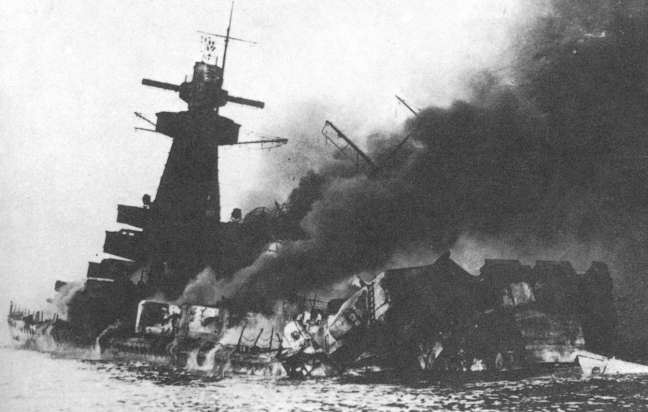
The period between the outbreak of the Second World War and the invasion of Norway is often called the Phoney war. Whilst on land this might have been the case, with the opposing army’s glowering at each other from either side of the Western Front, at sea it was an entirely different matter. Over 400 allied merchant ships had already been sunk, and the Royal Oak, the aircraft carrier Courageous, six destroyers and three submarines had all been lost. The Germans hadn’t come through unscathed either, losing amongst others seventeen U-boats, and the mighty Battleship Graff Spee.
So why invade Norway? Germany’s entire war production rested on the iron ore that she got from Sweden. However in the winter the Baltic ports froze solid, so the ore had to be transported by rail to Narvik in Norway which was ice free, and then shipped to Germany through protected neutral waters behind the chain of Norwegian islands. Something had to be done about this and Churchill, by now First Lord of the Admiralty, was all for occupying Norway as soon as possible. But for the politicians, this was fraught with danger. In the first place Churchill’s enemies kept harping back to his fiasco in the Dardanelle’s in the First War, and secondly, the Government felt that an occupation could only take place with the ascent of the king of Norway, as an outright attack on a friendly nation was not considered politically practical. In the end a decision of sorts was made to lay mines in Norwegian waters.
This it was hoped would drive the ore ships out of territorial waters where they could be seized by the British. It was fairly obvious that the Germans would react badly to this, so an expeditionary force was proposed just in case the Germans did decide to land in Norway. It was all to little to late because the Germans had already come to the same conclusions as Churchill, and they had also got wind of the British intention to mine the entrances to the fjords. In order to protect their source of iron ore, and not be forestalled by the British, they secretly planned their own invasion of Narvik. The operation was called ‘Wesserubung’ and it called for troops to be landed by ship simultaneously in the early hours of April 9th at Narvik, Trondheim, Bergen, Kristiansond and Oslo.
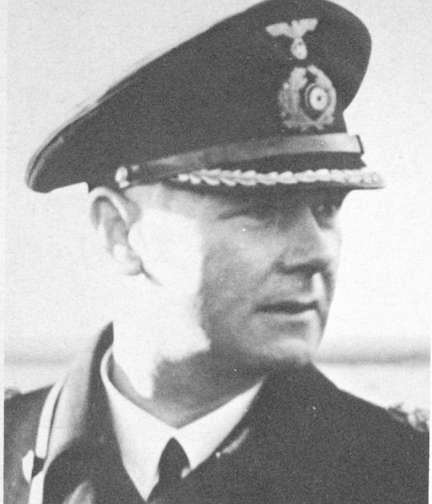
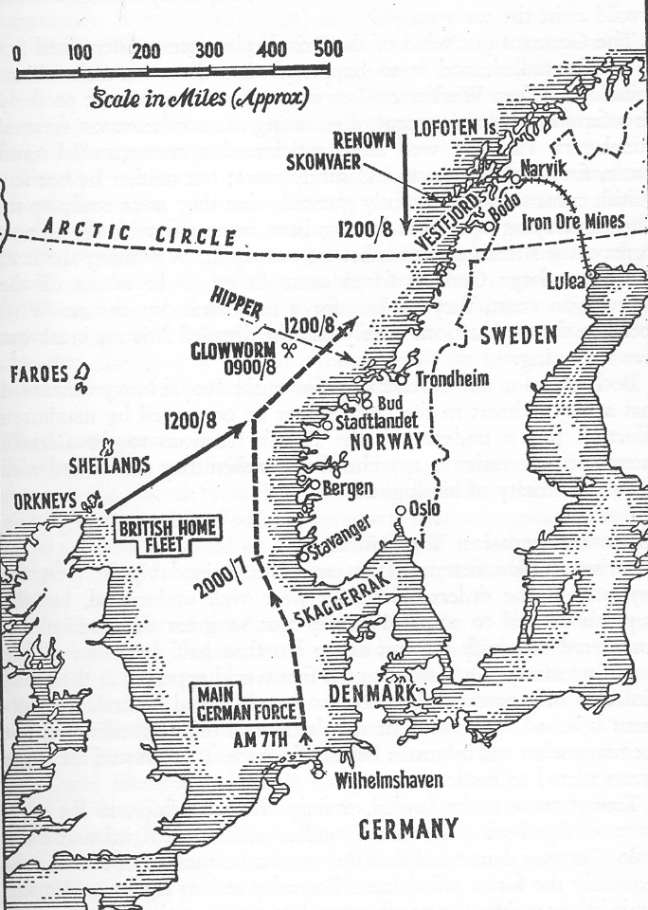
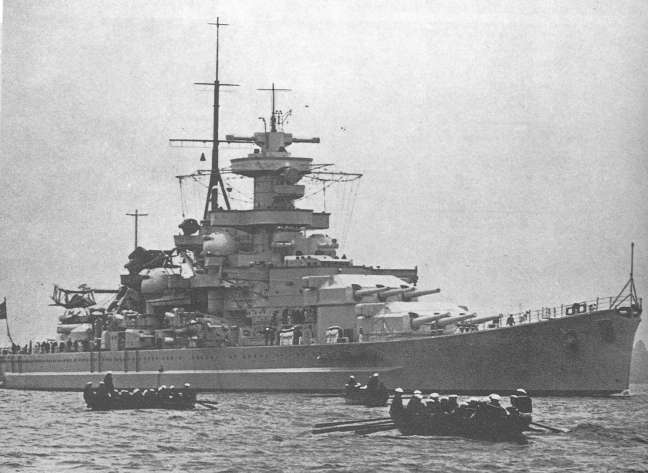
Ten destroyers under the command of Kommodore Fredrich Bonte comprised Group One of the invasion force bound for Narvik. Bonte had assembled his force at the north German port of Breverhaven, some 1020 miles from Narvik, and since surprise was essential it was decided to sail early on the 7th April and steam at 20 knots to the entrance of Vestifjord escorted by the battle cruisers Scharnhorst ,Gneisau and the Hipper, who was also carrying 1700 troops. The U-boat arm was ordered to support the operation with every available boat, and amongst those commanders present was the famous ace Gunter Prien, already showered with honours for the destruction of the Royal Oak.
At the same time as all this was happening, oblivious to what was going on, the British started their own, Operation Wilfred. This was to lay mines on the morning of April 8th off the outer shore of Vestfjord, and near Statlandet, with a dummy minefield off Bud Among the assembled Fleet were two Destroyer groups, Minelayers, and the Battle cruisers Renown, Repulse and Warspite So it was, that by pure coincidence, both fleets were at sea in the same area, but didn’t know it. Also, the British had not yet realized the Germans true intensions as previous intelligence on the subject had been either discounted or ignored.
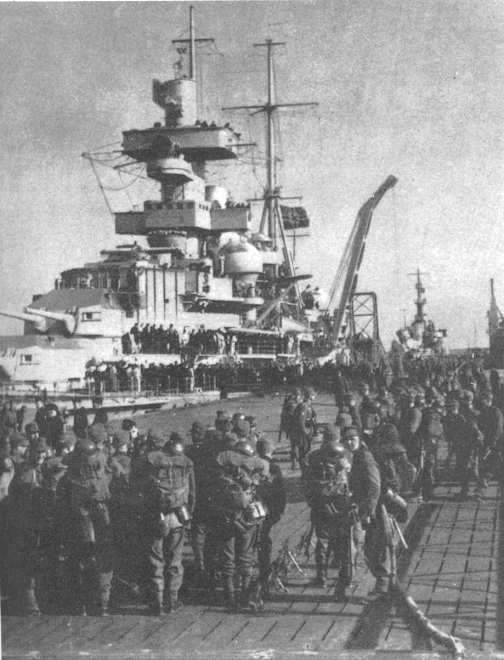
All that changed when H.M.S. Gloworm lost a man overboard in atrocious weather and turned back to try and find him. She ran slap into three German destroyers, who because of the heavy weather had got detached from their taskforce. She immediately opened fire on all three and sent off signals to alert the Fleet. The Gloworm didn’t have much chance of hitting anything as the sea’s were just too ferocious to provide a decent gun platform, and any way the German destroyers were more in danger from each other as they tried to take avoiding action.
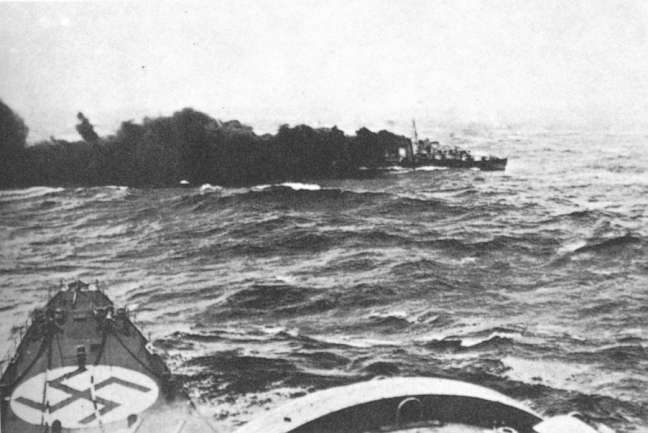
Meanwhile the Battle Cruiser Hipper arrived on the scene and proceeded to pound the Gloworm to pieces with 8 inch shells. In desperation the Skipper Lt. Roope fired his torpedos but missed as the Hipper dodged behind a smoke screen. However when the Hipper re-emerged from the smoke, she found the Gloworm closing at full speed. The ship smashed into the side of the Hipper, and all of a sudden her guns went quiet.The Hipper was severely damaged, but still managed to save the survivors from the Gloworm, 38 in all. Sadly the Captain was not among them. He was later awarded the V.C. posthumously.
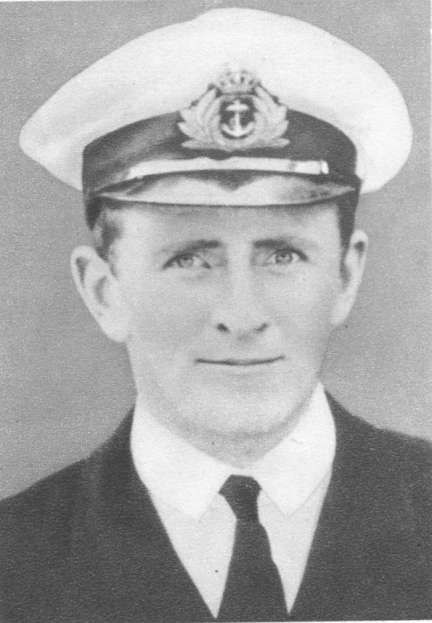
In an interesting development after Germany surrendered, the Hipper was found stranded at Kiel, and a plaque was found on one of her forward gun mountings. It read:

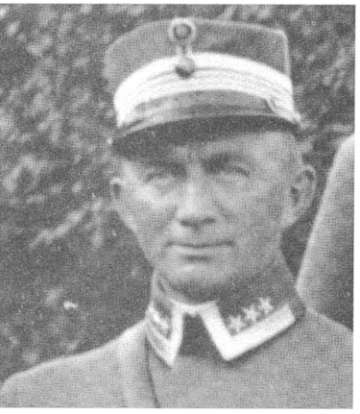
In the event the German Fleet evaded the British Fleet in the storm, and Bonte’s Group One, ended up positioned off the Norwegian coast during the daylight of 8th April. The Force entered Ofotfjord shortly after 4 am the next morning, sinking two ancient Norwegian warships, the Norge and the Eidsvold. The Commandant of the Norwegian Garrisson, Colonel Sundlo, who was German friendly, quickly surrendered, and one hour later Narvik was firmly in German hands.
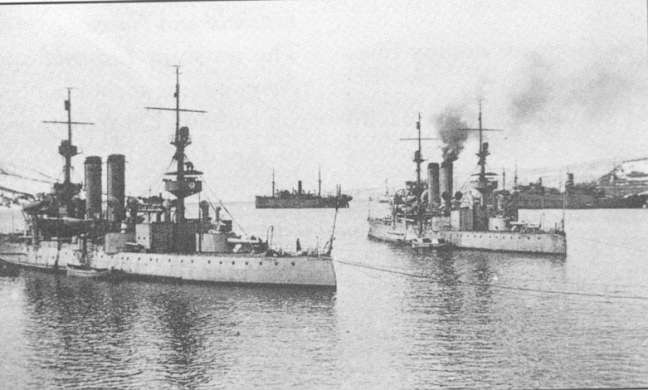
Meanwhile the Admiralty was still unaware of how many destroyers were in Narvik, sent a signal to Warberton- Lee in command of the Second Destroyer Group, saying that a German ship had landed a small force at Narvik. Warburton-Lee wasn’t convinced by this intelligence, so landed a party at the Pilot Station at Vestfjord to find out what was happening. When he realizes the true state of affairs he decided to launch a dawn attack.
At half past four that morning, it was snowing heavily, reducing visibility to less than a thousand yards. Leaving Hostile and Hotspur guarding the outer entrance, Warburton-Lee in Hardy, together with Hunter and Havalock swept into Narvik harbour sinking two destroyers ( Kommodore Bonte was killed in this attack)and damaging at least three others, whilst at the same time sinking several merchant ships. An hour later the British withdrew under cover of smoke, but ran straight into the remaining five German destroyers who sank Hardy and Hunter and severely damaged Hotspur. The remaining German destroyers that had so far escaped damage, retired into the shelter of the Fjords but now faced a real problem. Most of their ammunition had been used up and they were desperately short of fuel, so much so that they risked being permanently trapped in the Fjords. The rest of the British Fleet had now arrived, including the Battleship Warspite and the Aircraft Carrier Glorious, and so now had the advantage of overwhelming force. Quite why they waited three days to finish the job is unclear, but finish the job they did, sinking the rest of the German destroyers in a bloody, hard fought battle, in which the Germans fought down to the last shell.

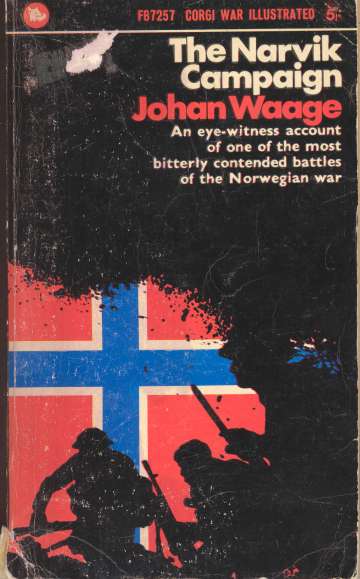
The Battles of Narvik and their causes are complex. I have drawn heavily on these two excellent books for information and understanding. Any mistakes, as ever, are mine, not theirs.
Today the two battles are commemorated by a Narvik Association, which holds an annual meeting of the survivors from both sides. The British did occupy parts of Norway, but with the German invasion of Belgium, the Netherlands and France, and the collapse of the Allies in this theatre of war, they had to evacuate, and on 24th May, the British reluctantly abandoned Norway to its fate.

Paul Armer says
Can anyone please help me find the location of MS Chrobry, bombed and destroyed 14th May 1940 carrying Irish guards.
best
Paul Armer
Hermann Falch-Olsen says
M/S Chrobry was put in fire the night between 14. and 15. of may 1940 by a Heinkel 111. Three Stuka-bombplanes sunked it in the morning on 16. of may 1940. 2 hunred people did not survived.
Position of the wessel:
Lofoten. Vestfjorden. Wreek. Position: ca. 67o 53′ 56″ N, 13o 29′ 52″ E (WGS 84)
?
Ron Cope says
Dear Hermann. Would you have any information I need for a book I am writing about 1st Battle of Narvik 10th April 1940. I know where she went aground. My father was a survivor on Hardy and I am gathering information from survivors and their family’s for a book based on personal narrative. It would be of great interest to have any Norwegian accounts. I am in contact with Geirr Haarr who has been helpful. I look forward to your reply with interest. Ron Cope ‘roncope@btinternet.com’
Submerged Comment says
Ron Cope (roncope@btinternet.com) wrote on 28 December 2013:
John Hague. It is with regret I have to inform remaining survivors or families and friends associtated with the 2nd Destroyer Flotilla in the 1st Battle of Narvik on 10th of April 1940, that John passed away on the 20th December 2013.
John was a 20 year old Stoker 1st Class on HMS Hunter, one of 39 survivors, who were eventually interned in Sweden. These survivors had to endure a long forced march with German guards over the mountains from Narvik. John being a keen Rugby League player from Oldham, his fitness not only helped him to complete the extremely difficult trek but also enable him to help another shipmate.
Approximately, 7 months into internment, John volunteered to be a crew member for the Norwegian cargo vessel ‘Ranga’ held in the port of Gothenburg. He and other volunteers were left in no doubt that it was a ‘life or death’ task, known as ‘Operation Rubble’. In January 1941 the mission was successfully completed, having avoided the German navy and attacks by the Lufwaffe aircraft. Finally,arriving in Britain with much needed supplies for the ongoing war effort.
Previously, John and his shipmates had been forced by the
Germans to sign a form, which meant if they were captured again, then it would lead immediately to a death penalty. Subsequently, John had to be discharged from the Royal Navy. However, he received a telegram from the Admiralty thanking him for his “Spirited and courageousness which enabled five merchant ships to reach this country with their valuable cargo”. He was awarded the British Empire Medal.
The story does not end there, John at the age of 88, with his large family in attendance, at the ‘Trafford’ branch of the Royal Naval Association, he was presented by the Norwegian Military Attache with the ‘Norwegian War Medal’.
This is a brief obituary to John, whom I had the privilege of meeting at his home, whilst researching for my book. His astonishing account will be a main feature, dedicated to those brave sailors involved in the most famous destroyer battle of the Second World War.
My sincere condolences goes to John’s daughter Carole and family, in the loss of a remarkable man. Ron Cope.
Alan H Spriggs says
My father, Cliff Spriggs, was a gunner on HMS Warspite during the second battle of Narvik.
I would like to make contact with anyone who knew him at the time.
I grew up with tales of this battle and would dearly love to visit the site of the battle.
Sadly my father passed away seven years ago.