
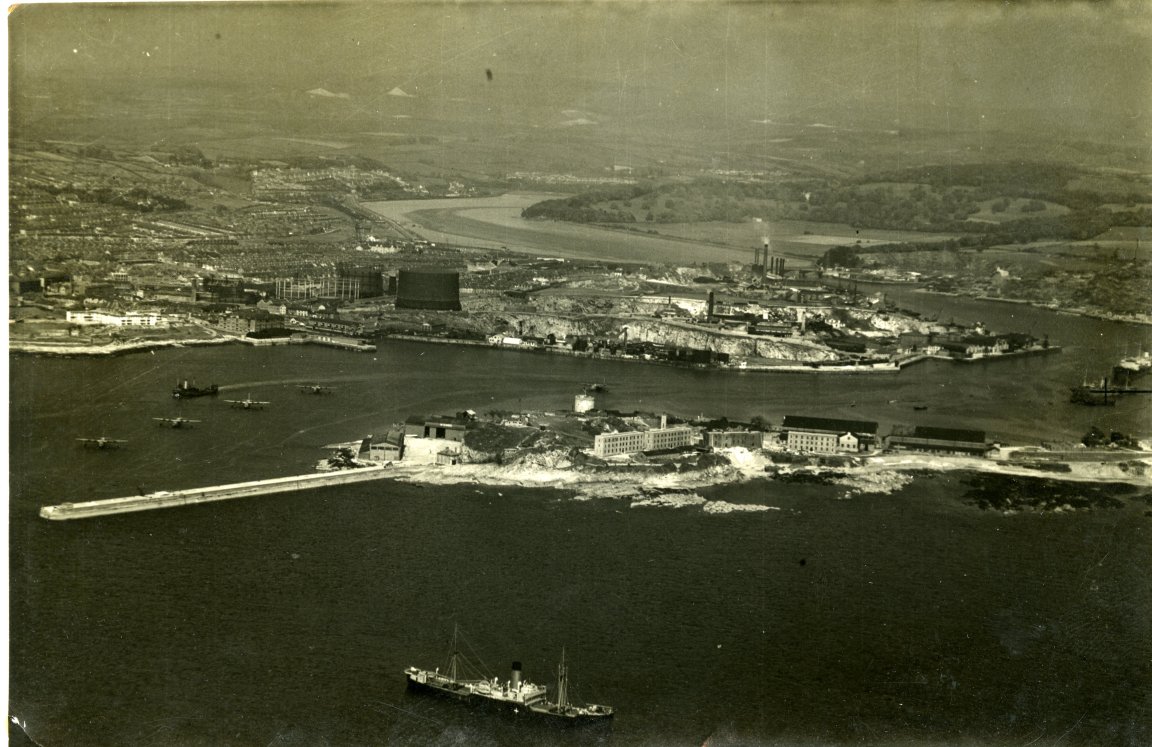
If you look across the Cattewater from the Barbican you can see the huge hangars that used to be part of R.A.F. Mountbatten.The whole site was handed back to the Council some years ago, and now thriving marine businesses occupy the hangars and yuppie housing occupies the land where the air base used to be. R.A.F. Mountbatten has virtually disappeared, its task completed and the past bravery and sacrifice of its various aircrews are now just fading memories.
There are several articles . The first one is about the salvage of a wrecked Sunderland and the re-uniting of it, and the crew. The second is the extraordinary tale of Capt. Frederick Thornton Peters who died in the above aircrash. The third is a gallery of photos from a relative, Flight Sgt W. Granger, who served at Mountbatten in aircraft maintenance. The fourth is about Lawrence of Arabia’s time at Mountbatten and his involvement in the development of the RAF rescue boats.

T R Mills says
It would be nice to know what the Naval Captain was awarded the VC for ?
I served my time in the RAF at Mountbatten and Calshot (5 Years)
Sam McBride says
Capt. Frederic Thornton Peters was awarded the VC in May 1943 for heroism in leading the Allied invasion of the port of Oran, Algeria in the early morning of Nov. 8, 1942 in Operation Torch. For the same action, Peters also posthumously received the U.S. Distinguished Service Cross. Peters was a Canadian who joined the Royal Navy in 1905 at age 15 and retired in 13, then rejoined the navy as a destroyer officer at the outbreak of WW1. He won the Distinguished Service Order for heroism in the Battle of Dogger Bank in January 1915 and the Distinguished Service Cross in 1917 for anti-submarine action. He retired after WW1 in 1919, and then re-enlisted in September 1939 at the outbreak of WW2. He won a bar to his Distinguished Service Cross for sinking two German subs and was then assigned as an instructor in Naval Intelligence before taking charge of Operation Reservist in the Anglo-American invasion of North Africa of November 1942.
Brian Rogers says
My father, Sydney Rogers, was a Lieutenant in the RAF meteorology service, Mountbatten, during this period. He is still alive (92 years of age) but has little recollection of events during that period – he has dementure and is in a nursing home. I am fairly sure he would not have got a weather forecast so badly wrong as described above. Does anyone remember him?
Donald Allison says
My father flew with No.10 Squadron from 39-45 from Mountbatten. I know his Sunderland crashed not far from Plymouth. He almost drowned and injured his back. Don’t know much more regrettably.
Helen Craig says
My dad flew with the No.10 Squadron as was a Squadron Leader on the Sunderlander Flying Boats looking for the submarines.
He has told me many stories of landing in the icy waters at Plymouth and limping into port with all the crew on one of the wings to keep it upright and floating into port. Unfortunately he passed away in 2006 aged 83 and never made it back to England to visit again but I will be doing that trip in 2012.
Pam Longe says
Raymond, I will ask my mother. My Dad was an engineer with 10th Squadron and I marched with him in Melbourne this Anzac Day. He was the only remember to march that day. My parents have a lot of information and books from the Sunderland Association. They may be your best contact. Black and white is probably about the only option. There was an article in the GW magazine in Saturday’s age featuring a picture of a boat with crew in front, this was used in an menswear store advertisement a few years ago. My Dad has a large copy of it on the wall.
Chris Tattersall says
My Dad was a navigator on Sunderland Seaplanes during the war. He was flying along the coast of Africa, protecting the merchant shipping lanes from U-boat attack as far as I can remember. He mentioned being in Freetown I think. I wonder if there are any other crew members who knew him there.
C.Allison says
An interesting narration concerning a very interesting aircraft, thank you for sharing this.
Heather Tweed says
Dennis Tweed has a new book about his experiences on Sunderland Flying Boats during the Korean War based at Seletar, Iwakuni etc…
There is a googlemap link from his website to some of the locations.
The book can be previewed at http://www.blurb.com/bookstore/detail/1661557
I just love the cover photo of him, Health & Safety?
Maureen says
Thank you for this fascinating account. My father was also a member of 10 Squadron. His plane, Sunderland DV969, was shot down over the Bay of Biscay in September 1943. No survivors or wreckage was ever found, as far as I know.
I too have several photographs of the crew and books about the Squadron, where my father is mentioned. He was posted os when I was 3 weeks old, so I never had the chance to know him. The older I get the sadder this makes me feel.
Dean Lance says
My Grandfather was a navigator and member of the 10 Squadronon Sunderland Seaplanes during the war. His plane, Sunderland W4020, was shot down over the Bay of Biscay on the 1st of August 1943 after engaging a U-boat. I wonder if there are any other crew members who knew him there.
Additional details
At 14.40 hours, the outbound boat was attacked by the Sunderland in the Bay of Biscay. AA fire hit the aircraft repeatedly, but the depth charges were right on target and broke U-454 in two. The flying boat tried to ditch due to the damages sustained and crashed, killing the pilot and five crewmen. Six survivors were picked up by HMS Wren of the 2nd Escort Group, while HMS Kite picked up the commander and 13 survivors from the boat.
Brendan Nicholson says
I read, many years ago, a book by a former U-boat commander whose boat was attacked by a Sunderland in the Bay of Biscay. He described how the aircraft, which he said was flown by an Australian sergeant-pilot, kept attacking despite heavy and accurate anti-aircraft fire until the Sunderland was heavily ablaze. It crashed into the sea with no survivors.
I, sadly, loaned the book to a colleague and lost it long ago.
Anyone know anything about that episode or who the Aussie pilot may have been?
Regards
Brendan Nicholson
Defence Editor
The Australian newspaper
[email protected]
Sam McBride says
I know that my greatuncle, Capt. Frederic Thornton Peters, VC, DSO, DSC and bar, DSC (U.S.), RN died in the Nov. 13, 1942 Sunderland crash near Plymouth, along with British Brigadier Frank Vogel (who worked in Eisenhower’s staff), but I have never seen the names of the other three passengers who died from the crash. It is remarkable that the 11 crew members all survived. The pilot, Wynton Thorpe, found Capt. Peters still alive in the water and tried to drag him to safety but gave up in exhaustion after about an hour because it was obvious Peters was dead from exposure (combined with injuries he suffered at Oran and in the plane crash). Thorpe died in 2008 at age 88. His family had donated his life jacket from the crash to the Australian War Memorial. I contacted his son, Brooke Thorpe, in Australia and had an interesting discussion. The Australians did not know the name of the “Naval Captain” until I confirmed with them that it was Capt. Peters.
Ken Harris says
I read with interest the comment posted by Dean Lance on Nov 4 2010 where he explains that his grandfather was on the Sunderland W4020 which was in action against U454 in Bay of Biscay and subsequently lost after sinking the u-boat on 1 Aug 1943.
My uncle, Flt Officer Hamilton Budd was on that flight, he may have been the pilot, but sadly was lost as result of this action with this u-boat.
Dean, I would love to make contact with you!!
Ken Harris.
Richard Gibbons says
Ken Harris. Did you know that your uncle Flying Officer Hamilton Roland Dacre ‘Bob’ Budd was a brilliant pianist and a graduate of the Sydney Conservatorium? He was the 2nd Pilot on Sunderland W4020 and Flight Lieutenant K G Fry was Captain. There were three pilots on board, all lost on that fatal flight. There is more info in the book “Maritime is Number Ten” by Flt Lt K C Baff, with the crew names etc. It would be interesting to know who Dean Lance’s grandfather was. Presumably on his maternal side as there was no Lance on W4020. The names of the six crew who lost their lives are commemorated on the Memorial to the Missing, Runnymede, UK. There were six survivors. You can contact me by email rmgibbons at hotmail.com using the subject heading Sunderland W4020 so I know its not junk mail. Richard Gibbons
David Ross says
My Grandfather FH Clarke registered number 7104 was alo a member of the 10 Sqd and also a Filight Engineer on DV969. He was not on th eplane (due to illness) the day it was shot down
Jos Johnson [ex 1238247 LAC Johnson G J ] says
I was the wireless operator on the RAF launch which stood by as the Royal Navy divers went down the day after the crash to recover the bodies. We brought back to Mountbatten the bodies, which the divers had handed over to us. The skipper of the launch was Corporal Boston.
Peter Mitchell’s information is thus very interesting to me because we were never told the identities of the crew or the passengers. The story I was given at the time was that the Sunderland had actually flown over the landing area, but could not get into the right landing position and therefore flew out to make another circuit.
On another aspect of life at RAF Mountbatten in 1942-1943, which has always fascinated me was the night flare path . It consisted solely of three whalers, each with an airman, an anchor, an accumulator and a pair of electric bulbs (perhaps about 12 watts apiece) at the top of a 6 or 8ft mast.
Bearing in mind the present night landing facilities, I marvel at the skills of the pilots who brought Sunderlands into Mountbatten at that time.
Greg says
My Grandfather also served with with 10 Squadron RAAF & sadly went down with his crew on DP179 (M for Monkey) on the night of 2nd October 1943.
If anyone is interested I have some original letters & correspondence from various 10 Squadron personnel at that time, including some mentioned here (F.H Clarke)
Greg
Barry Gollings says
Bought a dvd recently. watched it to-night and thought id investigate on the net-what a find. always been fasinated with Sunderlands And Catalinas. Great information.
Mark says
It would be only be right to list all the fatally injured passengers that were aboard the W6054. One of the passengers was my Fathers Uncle reporting back to the Admiralty from Malta.
Royal Army Brigadier F W Vogel
RN Captain G W Wadham
RN Captain R N Peters
RN Commander R R Devlin
RAF Sgt R E Cordrey (Ait Gunner)
Nice article and very informative.
Steve Baker says
http://www.military-art.com/mall/more.php?ProdID=4057
If Helen Craig is still looking for a print of a Sunderland taking off during the war can I suggest that she goes to the above web-site as they seel this for £13 sterling.
My father, Reggie Baker (callsign ‘LOCHINVAR’) flew Sunderlands from both Oban (Scotland) and Pembroke Dock (SW Wales). He then transferred to fighters and was eventually shot down and killed whilst flying as Wing Commander of two TYPHOON Squadrons in June 1944.
Graham Walker says
My father was killed when his Sunderland W3986 exploded 12 minutes after take-off from Mt Batten May 20, 1943, approximately 4 miles NW from the Eddystone Light. Only two of the bodies of the crew were recovered. The RAAF records are very vague about this. Is there anyone who knows about this incident.
tracy says
my great uncle was a rear gunner in a sunderland that crashed after take off on its way to gibalter in the lee on solent. all i have about the crash is that all 8 died and the sea was on fire for about 4 hours and they never found all the 8 men.I have 2 news paper clippings from that time so if anyone can shed more light on this it would be welcome my great uncles name was harry o keefe
tracy says
harry okeefe died 13 feb 1946 aged 19 sorry forgot to add that
Tricia Timmermans says
I have almost finished a book about my father (Aus/ 405206 Flt. Sgt. Edward Gallagher,10 and 461 Squadrons, R.A.A.F.) who was injured on February 20, 1942, when Sunderland “U” in which he was flying as a Wireless Air Gunner, crash landed on its return to Mt. Batten. “U” was repaired, but my dad, who suffered a head injury and was “out cold” for several days, was permanently injured. He continued flying until severe headaches and epileptic-type fits that developed, resulted in his being sent home to Australia in July 1943. He kept detailed diaries and wrote beautiful wartime sonnets, and as well, my mother (Molly) kept all of the letters he wrote while in training at Parkes and Evans Head (NSW) and while overseas. The book is a compilation of his diary entries, poetry, and letters, arranged chronologically. (It is interesting to compare what he wrote to my mum with what he wrote in his diary! He didn’t want her to worry, of course.) The book will be called “P.S. Love Me?” – which is what he wrote at the end of all of his letters, such were his doubts. It’s both a love story and a war story – one of separation, love, and longing. The words are all his. I hope it will be available at cost on Amazon.com before the end of October, 2013. There was a movie made by the Crown Film Unit for the Ministry of Information called “Coastal Command” which can be viewed on YouTube here:
http://www.youtube.com/watch?v=BssQCDqZXek You can buy a DVD copy here: http://www.periscopefilm.com. My dad, Ed, is the wireless operator seen at 51.38 to 51.50. (He says nothing, but in his diary he has a funny anecdote about what the “actors” really did say, as sound was added later, so that had open slather!) The clip is just after the co-pilot asks: “Any news of T for Tommy?” The film was directed by Jack Holmes, who was the father-in-law of a good friend, Diane (Watts) Holmes, who lives in Hampstead. Diane and I grew up together in Gaythorne, Brisbane. She moved to London in the sixties, so it was more than just a small coincidence that there is this connection! I moved from Australia to Canada in the seventies. My dad was permanently invalided because of the crash, and was put through all kinds of experimental treatments for head injuries; he died in Brisbane at age 70 in August 1986. If anyone knew my dad, or if you would like to know more about the book I hope to finish soon (I’ve been at it for years, so hopefully “soon” really does mean “soon”), please email me at tricia-at-photo-j.com. Tricia Timmermans, Victoria BC, Canada
Michelle Daniels says
Does anyone know if there are any existing Sunderland Flying Boats in the UK? My searches online seem to come to the conclusion that there isn’t. My grandfather was one of the engineers that built the Sunderland’s on the River Medway in Rochester. My grandfather engraved his initials in the pieces he built. It’s my father’s 65th birthday next month and I wanted to try and find somewhere where we could visit. I found the visitor centre at Pembroke Docks – would this be the best place? Hope someone can give some advice. Many thanks.
Submerged Comment says
Submitted on 2013/09/23 at 6:46 pm
Sue Hutchinson ([email protected]) wrote
Does anyone remember Grp.Capt.Pat Lombard….
I was at School with his daughter…he was an amazing fellow…
when I first met ..they were at MountBatten ..then either went to Pembroke Dock or Limavady N. Ireland…
Hope to have some news from ANYONE …!Sue
Submerged Comment says
Submitted on 2013/10/01 at 6:52 am
Heather Oldham ([email protected]) wrote:
My Uncle, Colin Stewart Cameron, was extremely excited when he was transferred to the famous No. 10 Squadron RAAF on 21 June 1943. He was a young 19 year old Australian lad who joined the Royal Australian Air Force and trained all over Australia before being shipped to USA and Canada for more training. He wrote many letters home (which were kept) and describes where he was and the friends he had made. He was then transferred from Moncton, Canada to Mount Batten RAF Base, Plymouth, England in June 1943. He was excited by all the travelling he had done but he missed home and had to wait many months before any mail caught up with him.
On 21st September 1943, after three months with 10 Squadron RAAF, he was shot down during a “Percussion” patrol across a section of the Atlantic Ocean. He was in a short Sunderland, DV.969 – E/10.
Notes from: Operations Record Book of No. 10 Squadron, R.A.A.F., held by the National Archives of Australia (online) showed that on 21 September 1943 “At 1611 hours an incomplete message read “0-A, 487,628? was received at Base but nothing further was heard from the aircraft, which is missing.”
Also that “Aircraft EK.572 – “F” with Captain F/L WILLIAMS, DFC, carried out an anti-submarine patrol during which at 1602 hours Radar contact was made with aircraft E/10 (DV.969). Ten minutes later an “0-A” message was intercepted from E (DV.969). This message was “487-6 JU.88?s” and then the message faded out with a high frequency note. (EK.572) F continued on the patrol and finally returned to base.
Also more notes: that on 22 September 1943 Aircraft W.4024 “G” (Captain F/L FARMER) took off on an anti-submarine patrol. At 1436 hours a message was recieved from Base MOUNT BATTEN – “Look out for Sunderland believed down yesterday 48°20’N. 12°30’W.”. An unsuccessful search was made for Sunderland aircraft DV.969-E/10?.
This reading is about 700kms west of Brest, France.
This was the crew of DV.969 – E/10 on 21st September 1943:
RAAF 409000 FO Jennison, A G Captain (Pilot) †
RAAF 420612 FO Buckland, A N (Pilot) †
RAAF 417178 FO Gunson, A W M (Pilot) †
RAAF 401768 FO Coomes, A L (Navigator) †
RAAF 17383 Sgt J T Law, (Flight Engineer) †
RAAF 19458 Sgt S C E Leech, (Fitter 11E) †
RAAF 408319 Flt Sgt N D K Swinton, (Wireless Air Gunner) †
RAAF 408410 Flt Sgt L E Waddington, (Wireless Air Gunner) †
RAAF 419929 Sgt J D T Daley, (Air Gunner) †
RAAF 415529 Flt Sgt D Harris, (Air Gunner) †
RAAF 422410 Flt Sgt C S Cameron, (Air Gunner) †
Does any one have photos of 10 Squadron RAAF that might have Flight Sergeant Colin Stewart Cameron. 422410?
Submerged Comment says
Submitted on 2013/10/11 at 4:06 pm
Valerie King
[email protected]) wrote:
There is a Sunderland Flying Boat at the RAF Museum at Hendon. In fact it is the actual plane that my late father Flt Lt Brian Landers flew when he was in Coastal Command in 201 Squadron.
Submerged Comment says
Submitted on 2013/10/13 at 9:00 pm
Owen Budd
([email protected]) wrote:
Dean and Ken, my relative was also Hamilton Budd, killed in the engagement with U-454. My parents still live in his home town!
Submerged Comment says
Submitted on 2013/10/17 at 8:39 am
Patrick Williams
([email protected]) wrote:
To Heather Oldham,
You might find a photo of your uncle on the Australian War Memorial website.
My own uncle, Lawrence Waddington was on the same aircraft as your uncle when it went down.
Submerged Comment says
Bruce Budd ([email protected]) wrote:
Reference my uncle, Hamilton Budd, known to his family as Bomb. He died just before my second birthday so although he met me I don’t remember him. Interesting to read Richard Gibbons’ comment that Bomb was a very good pianist which was true but he was a solicitor by training though I don’t know if he ever practiced. He was the youngest (I think) of seven brothers and two sisters. His eldest brother, Aubrey, fought in France during WW1 until it was discovered that he was only 15! Hamilton’s memory was always kept alive by the family and a number of his nephews went on to serve with the RAAF. One in particular, Rex Budd, won the DFC in Vietnam serving as a helicopter gunship pilot with 9 Sqn. Good to see Ken and Owen commenting.
Submerged Comment says
Valerie King ([email protected]) wrote:
There is a Sunderland Flying Boat at the RAF Museum at Hendon. In fact it is the actual plane that my late father Flt Lt Brian Landers flew when he was in Coastal Command in 201 Squadron.
Submerged Comment says
Warwick Dunbar ([email protected]) wrote:
I discovered and photographed this memorial photo of P/O (or F/O) Arthur Maurice Welch, a RAAF 10 squadron Sunderland W 4020 Second Navigator who was killed in action on August 1, 1943, at the museum of the Pyramid Hill Historical Society, Victoria, Australia in January, 2012.
link to photo:
http://www.flickr.com/photos/thaddeus_clarke/11364742364/in/photostream/
He is ‘fondly remembered’ as the Head Teacher from 1938-41. This school, in a hot, flat and scrubby landscape was some 400 km northwest of his home town of Traralgon in Gippsland.
Denis Saunders says
On 10 January 2013 Graham Walker wrote “My father was killed when his Sunderland W3986 exploded 12 minutes after take-off from Mt Batten May 20, 1943, approximately 4 miles NW from the Eddystone Light. Only two of the bodies of the crew were recovered. The RAAF records are very vague about this. Is there anyone who knows about this incident.”
My uncle, Flt Lt Denis Saunders, was the captain of 10/W3986 when she exploded over the Eddystone Light. I have quite a bit of information about the circumstances of the crash and the search that followed. If Mr Walker can post a contact on this site I can contact him and see if I can add anything to what he knows.
Suzanne sanders says
Anyone know of squadron 270 coastal command . Pilot c/o fish, pilot Knox pilot f/l stack .
Leon Murphy says
During WW@ a RAAF Sunderland operating in North Africa was shot down and crashed into the sea. One air gunner was shot and died of his wounds. The rest of the crew got ashore and proceed along the coast towards Alexandria in Egypt. When they eventually arrived in Alex they had 200 Italian prisoners. Tis was featured in Pix magazine in a two page coverage with quite a number of photos. I don’t know the names of any of the crew except Raymond Murphy the co-pilot. I would very much like to find a copy of that Pix magazine. If anyone can help me,please contact me on the email address [email protected]
peter bernardes says
The Ship’s project is attempting to discover any remains of the sunderland flying boats based at mountbatten but which sank during their time there.We have a considerable amount of information and aim to dive and map/photograph any thing we find. Any information that we can add to the history that we are building would be very useful. If you visit the following:-http://www.promare.co.uk/ships/ information on what we are doing is available. I look forward to hearing from you Pete Bernardes
Reg Stevens says
I am researching W R Cleland who was killed when W3986 exploded near Eddystone Lighthouse on 20 May 1943. Any info Graham Walker or Dennis Saunders (posted in this thread) can provide would be appreciated.
Mandy Larsen says
Hi Bruce
A group of pilots, engineers, friends and pastoralists are establishing the Rex Budd Memorial Park at the Mareeba Airport. Would be wonderful to make contact if you have anything you wish to contribute.
Kind regards
Mandy
L Bennett says
Hi, I am looking for information on the Sunderland ‘Golden Fleece’ X8274 which was lost in June 1941.
Any info on last flight crew, cargo etc. would be greatly appreciated.
Brian Axworthy says
At Mount batten there is a sunderland propellor that was recovered from the sea and is now on display near the landing steps, there is a plaque with more details about its recovery and which aircraft it was from. as a boy i lived Oreston and living next door was an Austrailan pilot called fitzpatrik and he was in No.10 squadron.
Caroline Skillicorn says
For Sam McBride: My father, Raymond B Wilkinson, was one of the crew who survived the crash in Plymouth Harbour on Friday, 13 November 1942. He was a Wireless Operator. He spoke to me about the crash three months before he died on Friday, 15 November 2002 aged 84. I have since printed out information about Capt. Peters and it is kept in an album along with photos of my late father.
Mark Evans says
My grandad was a rear gunner on a Sunderland. His name was warrant officer Roy Evans . I would love to know more about his military career and if anyone knew him
Martyn Van Lancker says
My father Peter Van Lancker was a tail gunner (known as a “tail end charlie”) in Sunderlands. If anyone recognises the name it would be great to hear from you.
Robert Campbell says
My Dad was Flt Sgt Bernard Campbell. October 1943 flying in RCAF Sqd 422 out of Castle Archdale, Northern Ireland, was shot down by two U-boats during an attack on convoy ONS 20. Unfortunately both boats were surfaced and ready for action when the Sunderland appeared on the scene. The skipper; Flt/Lt Paul Sargent passed twice over the U-boats dropping bombs and depth charges but the massive anti-aircraft armament damaged the Sunderland and killed Sargent, two gunners and a ‘passenger’ the gunnery officer from base. One U-boat U-470 was seriously damaged suffering casualties and the boat was visibly lifted out of the the water and was claimed sunk. The other unidentified boat escaped. 7 men including dad survived in the water (300 miles south of Greenland!) until they were picked up by convoy escort HMS Drury. Dad spent several weeks in NYC with his crew mates before returning to the UK and active duty.
Dad’s abiding memory of his Canadian crew mates was one of warmth and generosity!
Jim Coomes says
Maureen. My father was the navigator of DV969 in which your father was flying when it went down on 21 September 1943. I would be delighted to exchange information about the crew and the squadron with you.
Jennie Kershaw says
My Step father Leonard Henry Kershaw was stantioned with the 461 Anzac Sqaudron working as an Engineer on the Sunderland Flying boats. Does anyone have any pictures of the u it by chance?.
Jen Kershaw.
Frederick Newton-Brown says
G’day
i am after any info of the crew of DP179 that crashed on the night/morning of 2/3 October 1943.
if you have any info regarding the crew, more specifically pilot David Anderson 408946 please let me know.
Chris henry says
Hi. I am researching my uncle Flight Lieutenant Anthony P Cusworth, 204 squadron
He was a survivor of the ditched Sunderland P9060 and was rescued on April 23rd 1940. The details I have read, show his surname incorrectly as ‘Cushworthy’.I believe he was also a survivor of another Sunderland incident, where N9025 crashed into a mountain in Iceland in 1941….the details I have been able to view show a incomplete list of crew and passengers and I think Tony was a service passenger.
Would anyone be able to furnish me with any further information?
Thanks
Chris Henry (UK)
Steve Huk says
228 Squadron Sunderland N.9025 (F/Lt Smith, DFC) was shot down by Italian fighter (Colonel Luigi Monti) on 6th August 1940 off the Libyan cost while shadowing an Italian Convoy.
One crew member killed and four wounded.
Survivors were captured by an Italian Destroyer and became POW’s. The Sunderland sank while under tow by the Destroyer.
Chris Moseley says
My great uncle Richard (Dick) Neve . Flew in Sunderlands during ww2. We believe his aircraft was shot down over the channel. He managed to escape and was able to get into a lifeboat and was eventually rescued after several days. He never spoke of the incident as it obviously had great effect on him. Anyone have any information. I have very little information regarding his service only that he originally joined the flying Corp after ww1 and was obviously called back into service during ww2.
Dean Lance says
My Grandfather was a member of the 10 Squadron on the Sunderland Seaplanes during the war. His plane was Sunderland W4020 which was shot down over the Bay of Biscay on the 1st of August 1943 after engaging U-boat 454. I wonder if there are any relatives of crew members out there.
His name is 17142 Sgt F O Pettersson, (Fitter 11E/Air Gunner)
His daughters, my mothers maiden name is Patricia Pettersson
My email address is [email protected]