
Deliberately sunk to become an underwater classroom, the Glen Strathallan soon became a bit of an embarrassment, as it was a danger to local fishing boats and soon had to be disbursed. Over the years however thousands of divers have had their first wreck experience here, so in some ways it did fulfill its intended purpose.
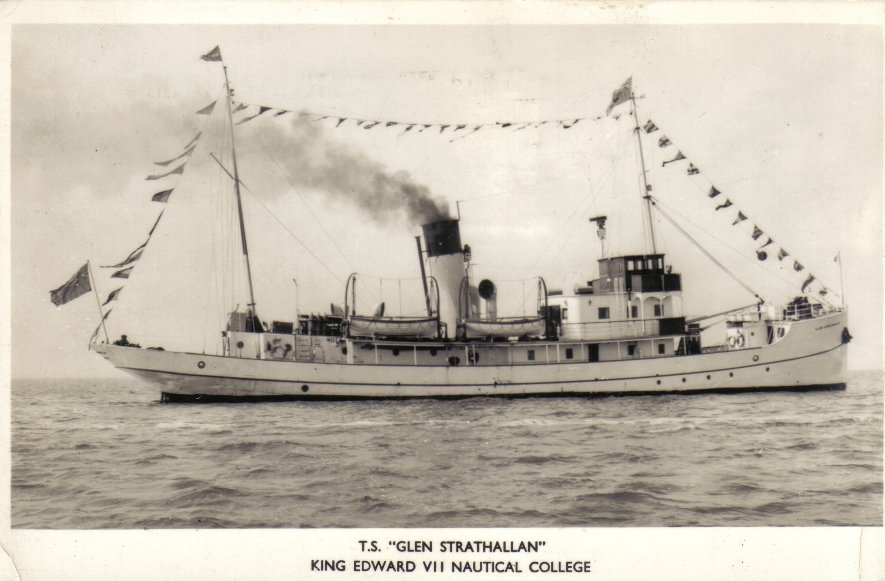
Photo courtesy of John Crossland.

ian walker says
A very interestng tale,thank you.I was fortunate enough to sleep one night on her in 1957 when I went back to see the Are. I often wonder what happened to the steam dingy as I am sure that would not have gone down with her.all the best,ian.
Nick Thornhill says
My dad was in the last crew to have been trained on her, he knew what had happened to her and was sad to see her go. sadly he died in april of 2007. Its nice to see he had a claim to fame, 1 of the last to operate the engine that now sits in the science museum :)
David Godfrey says
I did two short trips on the Glen when I was at Norwood Tech in 1965 while studying to be a Radio Officer. I remember it being very cramped both in the accomodation and the eating areas. Also, recall doing anchor watch during the night while anchored out in the Estuary and peeling spuds to pass the time. But it is a good memory to have steamed back up the River into Milwall Docks. I was at the Science Museum on a trip back to England this year and did not know the old triple expansion steamengine was there. It would have been very nostalgic to see again.
Brian Biggs says
I looked up about the Glen Strathallen on Wikipedia and was surprised to find the video of the sinking. I was the Mate of the Sun 27 that towed the ship from Gravesend to the sinking position which as you can imagine was quite an event. It took us some 8 days due to stress of weather. I still have colour slides of the sinking and are part of my collection followings some 42 years in the Ship Towing industry
John Crossland says
I did several trips down to Southend and back, while at King Teds during 1966/1967.
The name is GLEN STRATHALLAN by the way.
John Crossland says
Hi Peter,
I see you have posted “John Crossland’s memories”, but still have the spelling as either Glen Strath Allen or Glen Strathallen.
Please change the spelling throughout your website to GLEN STRATHALLAN.
David Cornes says
I dived on her the day after she was sunk, it was quite an experience. I can remember swimming along the alleyways. The funnel was only just beneath the surface I remember.
Douglas Brown says
I was the Poplar Tech. Lecturer, 1965-70, in charge of the engineer cadets on board the Glen. Prior to that the cadets were in the care of Roy Hotten. I had about six at a time. Radio cadets were in the care of Bruce Purslow who had been a personal friend of Colby Cubbin.
The person who accompanied the Glen to Plymouth for the sinking was Edward Clifford Hayden who took cine film of the event.
Later on, when he was at Wandsworth Technical College I, along with the students, helped in the production of a video based on the Glen as a project. It worked out well but I do not know what happened to the video.
Geoff Hudson says
Wow, following a chance meeting with a Superintendent buddy from way back I Googled the Glen. She was in no small measure responsible for my lifelong love of steam propulsion. I seem to recall a boiler efficiency of about 11%. We were threatened with the engineers bilge dive whilst moored in the Estuary. Started my career at Poplar Tech. Seem to remember a tutor called Gordon Bennett and one named Rabone from the Annexe in Limehouse. Gonna have to break out the wetsiut and pay my respects.
steve says
I went to the Science Museum yesterday. There was no trace of the Glen Strathallan engine and the people on the information desk had never heard of it! It was definitely still there when I went a couple of years ago.
The shipping and diving section has also been cleared out to make way for a new “exciting” and “innovative” interactive communications gallery…
Peter Mitchell says
Steve,
you are right about the engines disappearing, but they are at their storage facility up contry.
peter
Ian says
The Glen Strathallen was owned in the 30s etc by an Isle of Man millionare called Coby (or could be Cody) Cubbins and my grandfather was a sailor on this ship. Apparently Mr Cubbins was rather eccentric has he only sailed this ship from the IoM to the locks of Scotland. His other trait was that he lived mainly off cake. He died at the age of 45 ish
Hannah says
Dived on her last weekend, amazing to see it in winter and the different sea life.
Douglas Brown says
STILL TRYING TO LOCATE THE VIDEO THAT WE DID AT wANDSWORTH COLLEGE.SOMEONE MUST HAVE IT.
Geoff Wood says
Doug,
There is a short seemingly well presented documentary on you tube based on the sinking of the Glen Strathallan – maybe this is what you are searching for !.
I did a stint on the ‘Glen’ in May ’64 as a cadet marine engineer and found it both interesting and relevant
Joe Hulse says
Spent a week on her in 64, when she was as the Sea Training ship for TS Arethusa, moored on the Medway at Upnor. Very enjoyable. Remember the “Call the Hands” words. Wakey Wakey, Hands off @*$^ grab a sock Tea’s on the hot plate ! Last saw her moored off Cowes behind a Sun Tug on her way to be scuttled. Nice to find this link to the past.
Edward Clifford Hayden (Cliff)! says
Edward Clifford Hayden says
I was responsible for the cine film taken during the sinking of the Glen Strathallan ; it was quite an adventure for me and I shall never forget it.
A diary of the whole exercise would prove very interesting, enjoyable and certainly humorous!
Doug Brown, a student technician team and I produced, what we and an ajudicator, thought was
an interesting bit of history.
Whilst I have a reel of most of the film -silent- I think the finished article was acquired by a Naval Historical organisation in a video format.
Colin Smith says
I too spent a week on the Glen in 1965 while doing pre-sea at King Teds. She was tied up att the garbage wharf in Millwall Dock. Mate was named Mann. No comment. Skipper was a decent fellow. Remember him kicking the wheel when the budding QM would put it the wrong way. Best feeder ever. The cook was a legend. Don’t know how he made it taste so good. Anchored in the Medway in October, when l had to dive overboard and right the life raft.Nice ship. Sad they couldn’t keep it intact, but had to blow it apart to prevent it fouling fishing nets, etc.
Rowland Humble says
What happen’d to the “Glen Strathallan ‘s” steam whistle.
Does anyone know?
John Handley says
I remember sailing on this ship in 1969 when I was at Poplar College ( Marine Engineering department).
I clearly recall going up and down the Thames and operating the triple expansion recip engine. Me and my college mates and had a great laugh.
The next time I was at sea (the next year) I was a cadet engineer on Texaco Europe . Quite a difference in size !
Keith Wakefield says
I had the pleasure of being one of the last engineering cadets to sail on her in 1969. I was studying at Poplar college as a Furness Whity cadet. I remember anchoring off Southend and doing a night watch when the Navigating cadets on watch thought we were dragging the anchor, all hell let loose and we got ready to flash up but they had been taking sights on a moving bus!!
I remember my fellow cadet Howard Smith who was with Shaw Savile and the time spent on her will be well remembered